Understanding your symptoms
Why does my bladder hurt when there is no infection?
Bladder pain with a clean urine test is a real experience — and a common one. Understanding what can cause it is where making sense of the symptoms starts.
By Intero · Updated June 15, 2026 · 7 min read
Intero is observational, not diagnostic. Journal content is informational only and is not medical advice.
Bladder pain with a clean urine test is real and common. Here is what causes it, why a negative culture is a starting point, and how tracking symptoms helps.
If you have had bladder pain or pressure and the urine test came back normal, you may have left the appointment without a useful answer. Negative means no infection. It does not mean nothing is wrong. Bladder pain without an infection happens for several reasons, and it has names.
The most common is interstitial cystitis — a condition affecting the bladder lining that produces symptoms nearly identical to a UTI: urgency, pressure, burning, and frequency, without any bacterial cause. Others include overactive bladder, pelvic floor muscle tension, and conditions that can refer pain into the pelvic region. Getting to the right one takes time. Understanding the possibilities is where that process starts.
Keep a symptom history with Intero
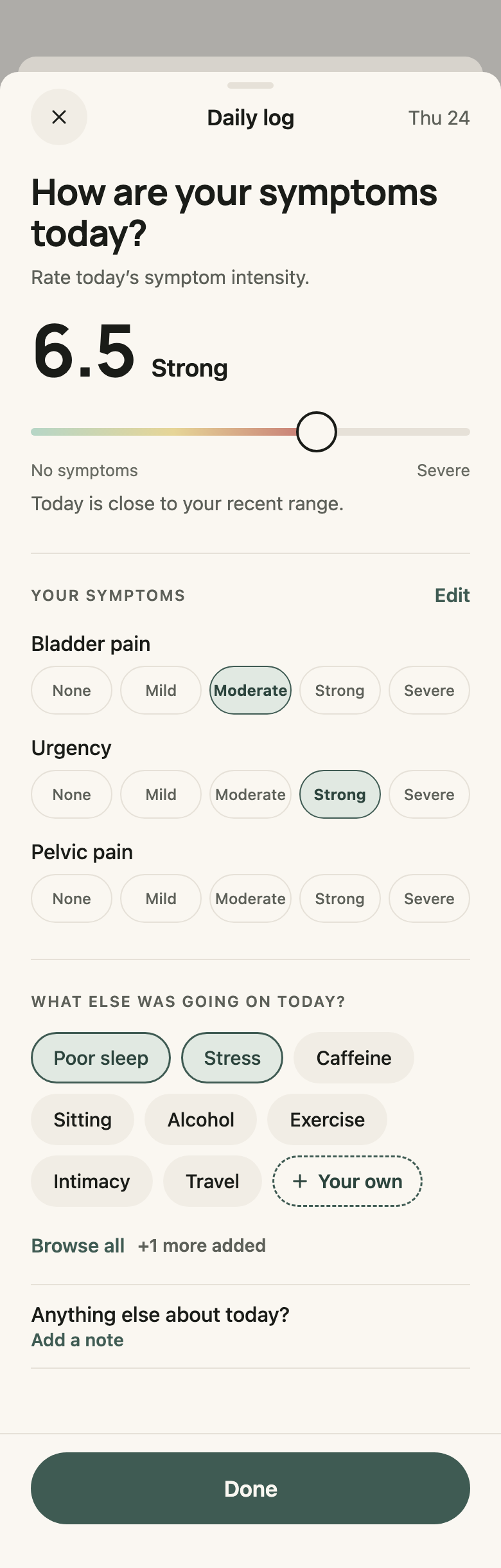
Start with a daily entry, then build a record you can return to.
- Record symptoms and context.
- Review your history over time.
- Prepare a summary for appointments.

What a negative result does and does not tell you
Urine cultures look for bacterial growth. When bacteria exceed a diagnostic threshold, the result is positive and a UTI is confirmed. When they do not, the result comes back negative. What the test cannot tell you is why you are in pain. The absence of bacteria explains what the cause is not. It does not explain what it is.
This leaves a lot of people with a real experience — pain, urgency, pressure — and no clear explanation to take home. That gap is frustrating, and it is not unusual. A significant number of people with persistent bladder symptoms have negative cultures on testing. The medical umbrella term is sometimes "bladder pain syndrome." What it means in practice is that the symptoms are real, infection is not driving them, and figuring out what is requires more than one test.
What actually causes bladder pain without infection
The most commonly identified cause is interstitial cystitis. IC affects the bladder lining and produces urgency, burning, frequency, and pelvic pressure without any bacterial component. Its exact mechanism is not fully settled, but the symptom pattern is consistent: it comes and goes, it shifts with sleep and stress, and it does not respond to antibiotics.
Overactive bladder is another possibility. OAB involves urgency and frequency that can be accompanied by pelvic discomfort, though significant pain is not always part of the picture. Pelvic floor dysfunction — specifically muscles that are too tight rather than too weak — can produce pressure and pain that is easy to confuse with bladder symptoms. Bladder pain also appears in some cases of endometriosis, where tissue grows on or near the bladder.
There is also a category sometimes called urethral syndrome, and some people experience what feels like bladder pain as a referred symptom from the broader pelvic region. Which explanation fits depends on the full picture — how symptoms behave over time, what makes them worse, what else is happening in the body on days when symptoms got worse.
"No infection" is a starting point, not an endpoint
Getting a negative result can feel like a door closing. The test found nothing. But a negative culture is useful information. It rules out the most common explanation and points toward a different one. That is a step forward, even when it does not feel like it.
The conditions that cause bladder pain without infection are harder to identify quickly. They often require ruling things out one by one, and seeing a specialist — typically a urologist or a pelvic floor physical therapist — is usually part of the process. IC in particular has no single definitive test. The diagnosis is built from symptom history, ruled-out alternatives, and often a cystoscopy or urodynamic evaluation.
The place most people get stuck is in the gap between the negative test and the specialist referral. That gap can be long. While you are in it, the most useful thing you can do is build a clear picture of what is actually happening — not from memory, but from a record.
What paying attention to patterns reveals
Bladder pain that comes and goes without a bacterial cause usually follows patterns, even if they are not obvious at first. It may be worse on certain days. It may show up alongside poor sleep or elevated stress. It may respond to certain foods or prolonged sitting. Those connections only become visible when you have enough data to see what changed before symptoms got worse.
Keeping a simple daily record — urgency level, pain or pressure, frequency, and basic context like sleep and stress — across several weeks builds the kind of picture a urine test cannot. You start to see which days are harder, what appeared around them, and how long the rougher stretches last.
That record does not diagnose anything. What it does is change what happens at an appointment. Instead of describing symptoms from memory — "it comes and goes, it has been pretty bad" — you can show what actually happened. That is the difference between a doctor hearing a summary and seeing a pattern.
Why this matters
Bladder pain without an infection is real, but the path to understanding it is not fast. Negative tests are a starting point. Most people spend time in a gap between "it is not a UTI" and getting an answer that actually fits.
Tracking symptoms consistently while that process unfolds gives you two things: a clearer picture of what your body is doing, and something concrete to bring to the clinician who will eventually help you figure out why.
Common questions
- What causes bladder pain when there is no infection?
- The most common cause of bladder pain without a bacterial infection is interstitial cystitis — a condition affecting the bladder lining that produces urgency, pressure, and burning without any infectious component. Overactive bladder, pelvic floor muscle tension, and endometriosis can also produce symptoms that feel like bladder pain. Identifying the cause usually involves ruling out other conditions with a urologist.
- Is bladder pain without a UTI serious?
- Persistent bladder pain with consistently negative cultures is worth investigating with a specialist. Conditions like interstitial cystitis are not emergencies, but they are real and benefit from being properly identified. A urologist is the right starting point for ongoing bladder pain without an infectious cause.
- Why does my bladder feel full and sore all the time?
- A persistent feeling of pressure or fullness that does not resolve after urination is a common description of interstitial cystitis. It can also be a feature of overactive bladder or pelvic floor muscle tension. When the feeling is continuous and cultures show no infection, it is a symptom pattern worth tracking over time and discussing with a urologist.
- What is the difference between bladder pain and a UTI?
- A UTI is caused by bacteria and will show on a urine culture. The pain typically resolves with the right antibiotic. Bladder pain without an infection does not have a bacterial cause and will not respond to antibiotics. Symptoms can look and feel similar in the moment — urgency, burning, pressure — but the absence of infection points toward conditions like interstitial cystitis that require a different approach.
Sources