IC and pelvic health
Interstitial cystitis symptoms: what they look like and what they can tell you.
IC is usually described as bladder pain. That description is accurate but incomplete. The symptoms span pressure, urgency, burning, and frequency - and they shift enough from person to person that understanding your own version is a separate task from understanding the condition in general.
By Intero · Updated June 15, 2026 · 8 min read
Intero is observational, not diagnostic. Journal content is informational only and is not medical advice.
IC is called bladder pain, but the symptoms span pressure, urgency, burning, and frequency. Understanding your own version takes consistent tracking over time.
Interstitial cystitis symptoms are often described as bladder pain. That framing is accurate, but it leaves a lot out. There is the pressure that builds and does not fully release after urination. The urgency that arrives fast, sometimes every hour, and does not always match how full the bladder actually is. The burning that follows a bathroom visit. The days where sitting too long makes everything worse. The way symptoms that were manageable last week are now hard to get through.
Most people receive an IC diagnosis after a long process of ruling things out - urinary tract infections that were not infections, tests that came back normal, symptoms that were real but did not fit a clean explanation. By the time a diagnosis arrives, many people have spent months or years trying to understand what is happening. The diagnosis names it. It does not usually come with a map of how the condition behaves in your specific body.
Download a printable symptom diary
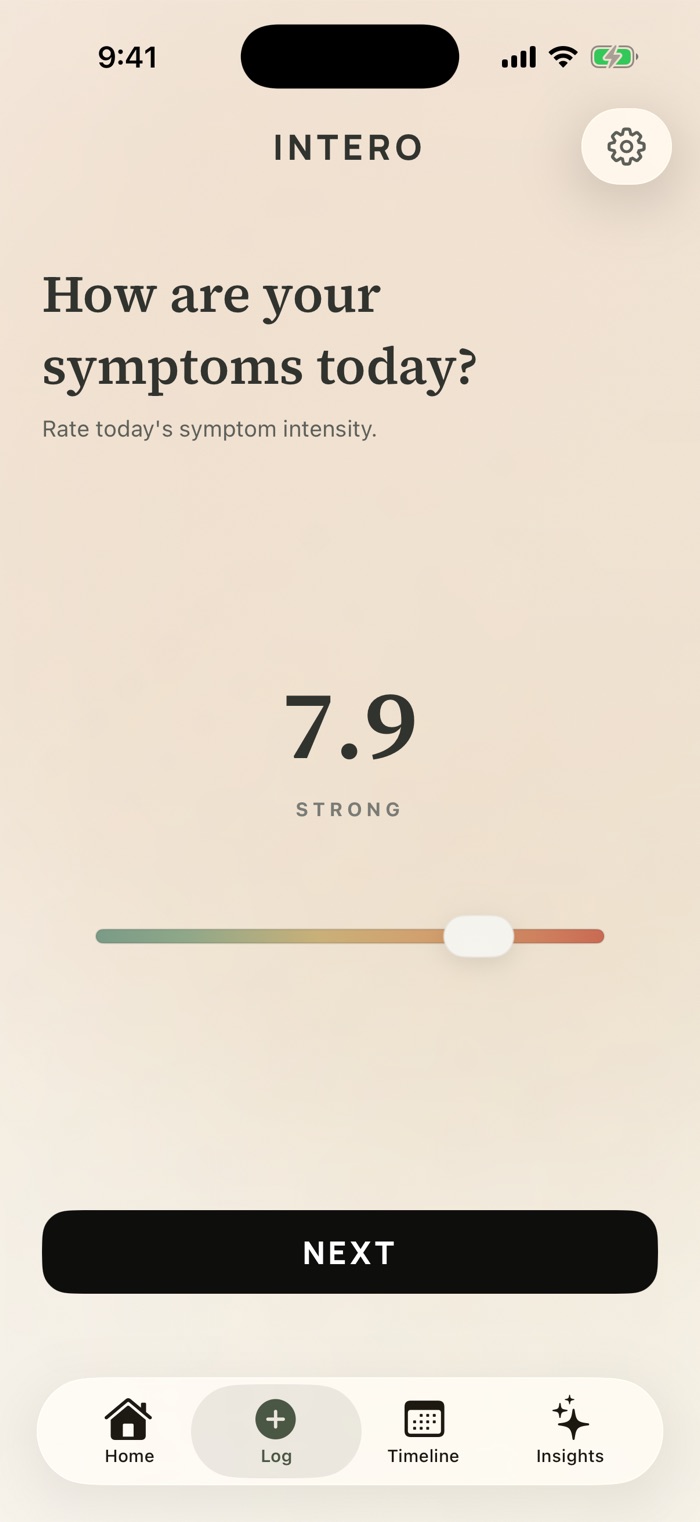
Use the PDF today, or track the same symptoms on iPhone with Intero:
- Built for IC — no setup.
- See what shows up before flares.
- Keep a flare history for your specialist.

What interstitial cystitis symptoms actually feel like.
"Pain" is the word that shows up most often in IC descriptions, but most people with the condition reach for something more specific. Pressure. Fullness that does not go away. A burning sensation during or after urination. Urgency that arrives suddenly and does not wait. High frequency - needing to urinate far more often than feels normal. Some people experience pain with sex. Some find that certain foods push symptoms into a harder range within hours. Some notice that a poor night of sleep or an elevated-stress week changes things in ways that take a few days to show up.
IC affects the bladder lining, and the exact mechanism is still not fully settled. What is settled is that the symptoms are real, they are not caused by infection, and they affect how people move through their days in concrete ways. The experience varies enough between individuals that two people with the same diagnosis may not recognize themselves in each other's description at all. That is not unusual for a condition this variable. It means understanding your own version of interstitial cystitis is its own task - one that takes time and a record.
Why interstitial cystitis symptoms shift so much.
IC does not hold steady. Symptoms flare. They recede. Good days exist, and they are not a sign the condition has resolved. Bad days arrive and do not always have a clear explanation you can name in the same hour.
Part of what drives this variability is what researchers and clinicians sometimes call the accumulation effect. Sleep quality, psychological stress, dietary inputs, prolonged sitting - none of these reliably produces a flare on its own. But when several arrive in a short window, the cumulative load can push the bladder past a threshold it has been managing quietly. That threshold is not fixed. It shifts depending on your baseline. A dietary choice that lands fine on a well-rested week may hit differently after two nights of poor sleep.
This is why the search for one consistent trigger often does not lead anywhere useful. The pattern is usually more conditional than that. It is the combination, at the wrong time, that can show up before symptoms got worse.
What a diagnosis does not give you.
A urology appointment is typically 15 to 30 minutes. That is enough time to discuss your current symptom level, review what treatments you have tried, and decide what to adjust next. It is not enough time to trace six weeks of fluctuating interstitial cystitis symptoms, reconstruct which weeks were harder and why, or identify what has changed since the last visit.
"How have your symptoms been?" is a hard question to answer usefully when you are working from memory and the symptoms have varied a lot. The answers tend toward generalities - worse than usual, pretty bad, about the same - which are accurate but do not give a clinician much to work with when deciding what to try next.
Those appointment conversations go better when there is a record of what actually happened across the weeks before them - captured close to when it happened, not reconstructed from memory. What changed before symptoms got worse. What weeks looked steadier. What shifted.
What tracking interstitial cystitis symptoms over time reveals.
A symptom record does not make IC simple. What it does is make the pattern legible. Over several weeks of consistent logging - symptom level, sleep, stress, diet, activity - the same conditions can appear before symptoms get worse. How long it takes to settle after a flare starts to look consistent. The baseline during a steadier week becomes measurably different from the baseline during a rougher one.
That kind of pattern takes time to see. A few days of data does not show much. Four to six weeks tends to be where patterns start to repeat enough that you can trust what you are seeing. The point is not certainty - it is the difference between guessing and having something grounded to say.
That record has two uses. The first is personal: it builds a clearer picture of your own version of interstitial cystitis - what appeared around rougher days, what the steadier stretches tend to look like. The second is for appointments: it gives your doctor something more useful than your best reconstruction from memory of how the past several weeks went.
Why this matters
IC symptoms change constantly, and the reasons they change are often buried in days of context that is hard to hold in memory. A flare that feels sudden usually has a run-up. Without a record, that run-up is invisible.
Consistent tracking builds a picture of your own version of IC - not just the condition in general. Over time, the pattern of what appeared around rougher days becomes something you can see and describe. That changes what you can bring into a conversation with a clinician, and how clearly you can describe what you have been noticing.
Common questions
- What are the most common interstitial cystitis symptoms?
- The most common interstitial cystitis symptoms include pelvic or bladder pressure or pain, urgency that arrives fast and does not fully resolve after urination, burning, and high urination frequency. Some people experience pain with sex or worsening symptoms after certain foods. The symptoms vary enough between individuals that two people with the same diagnosis may describe very different day-to-day experiences.
- Why do interstitial cystitis symptoms come and go?
- IC symptoms fluctuate because they tend to respond to accumulation rather than single triggers. Sleep disruption, stress, prolonged sitting, and dietary factors can each nudge symptoms without causing a flare on their own. When several of these arrive in a short window, the cumulative load crosses a threshold and symptoms escalate. This is why flares can seem unpredictable: the cause is usually a combination of inputs, not one isolated event.
- How do I know if my bladder pain is interstitial cystitis?
- IC is typically diagnosed after ruling out other causes, including bacterial infections, structural problems, and other conditions that can produce similar symptoms. If bladder pain, pressure, or urgency persist when cultures show no infection and other tests are normal, IC may become part of the clinical conversation. A urologist familiar with pelvic conditions is the right person to make that determination.
- Can tracking symptoms help with interstitial cystitis?
- A record that captures symptoms alongside context — sleep, stress, diet, and activity — can show what conditions appeared around rougher days. Over four to six weeks, patterns start to repeat enough that you can trust what you are seeing. That is useful for building a clearer picture of your own version of IC, and for appointments, where a structured record gives a clinician something more specific to discuss.
Sources