Pattern insight
Understanding the lag.
Symptoms do not always line up neatly with the same day. Sometimes the clue sits earlier, in the accumulation, or in the part of the story most trackers let disappear.
By Intero · Updated June 15, 2026 · 8 min read
Intero is observational, not diagnostic. Journal content is informational only and is not medical advice.
Pelvic and urinary symptoms can show up a day or two after the surrounding context changed. Here is why the lag matters, and what it means for tracking.
People with pelvic and urinary symptoms often do not need more entries. They need a record that preserves what came before the change. That is what makes the difference between "I had a bad day" and "I can see the same pattern showing up again."
The lag matters because it changes what a useful symptom history has to keep. If the useful clue sits earlier, then a tracker built around the same-day moment is always going to feel thinner than the body experience it is trying to capture.
Keep a symptom history with Intero
Start with a daily entry, then build a record you can return to.
- Record symptoms and context.
- Review your history over time.
- Prepare a summary for appointments.
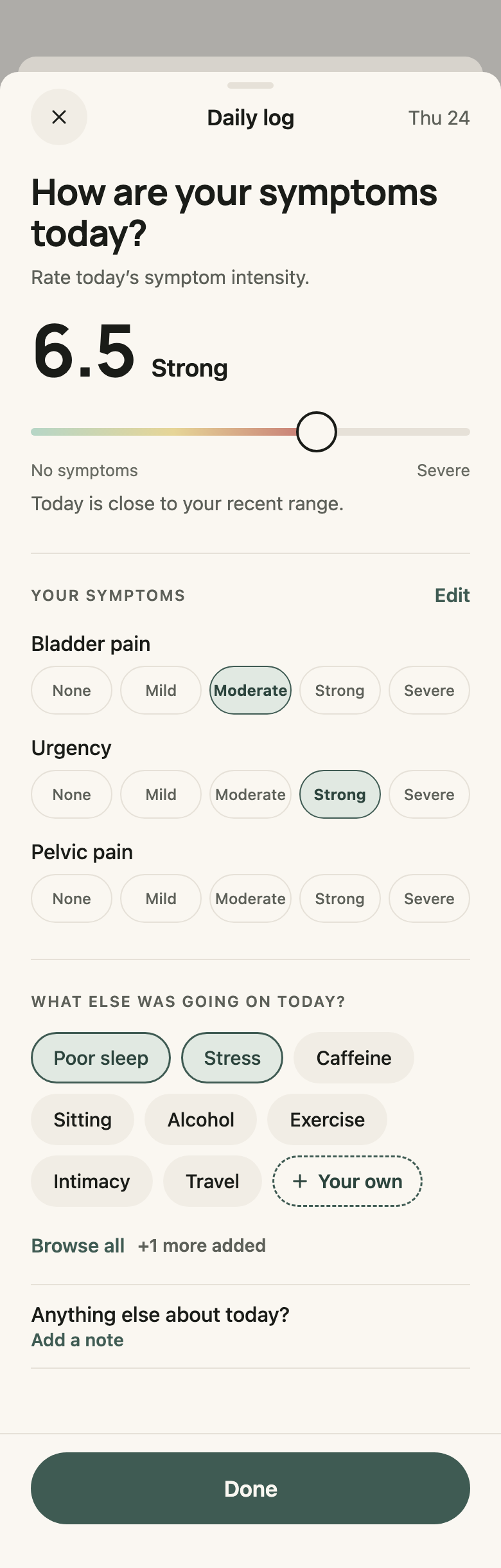

Symptoms can arrive after the thing that mattered.
A rough day does not always begin with the thing that happened this morning. Sometimes the useful clue sits in yesterday's sleep, two long days of sitting, a hard travel day, or a stretch of stress that only shows up later.
That delay is one reason pelvic and urinary symptoms can feel random when they are not. If the record only captures the present moment, the earlier part of the story disappears.
Same-day guessing breaks down quickly.
A generic tracker can leave the user staring at isolated entries: one flare here, one bad sleep there, one difficult commute somewhere else. The pieces are present, but the sequence is not.
A useful tracker has to keep enough surrounding context that the user can look back across several days instead of trying to explain a flare from the same afternoon alone.
The useful pattern is often in what came before.
That earlier stretch can include sleep debt, stress, sitting, activity, travel, hydration changes, or a stack of smaller inputs that do not mean much alone. The point is not to force one explanation too early. The point is to preserve the conditions around a change well enough that a pattern can become visible.
When the same sequence repeats more than once, the user has something better than a hunch. They have language that can hold up in their own mind and in an appointment.
A useful record has to stay honest.
Not every rough day means a pattern has been found. Intero can help distinguish what is repeating, what is only emerging, and what still needs more time.
That matters because the aim is not to make the data feel smarter than it is. The aim is to return something clear and specific enough to actually use.
Why this matters
A useful symptom record cannot behave like a generic tracker with medical nouns pasted over the top. It has to preserve what came before a rough symptom day well enough that the user can return to it later and still recognize the story.
That is why sequence matters so much here. When the useful clue sits earlier, the record has to be built to hold onto it.
Common questions
- What does symptom lag mean?
- Symptom lag means the symptoms that feel worse can show up after the thing that contributed to them, often a day or two later rather than in the same moment.
- Why do symptoms sometimes appear a day later?
- Pelvic and urinary symptoms often reflect accumulation. Sleep loss, stress, sitting, or other inputs can build across time and only become obvious after the load crosses a threshold.
- Why is lag important for symptom tracking?
- Lag changes what a useful record needs to keep. If the clue sits earlier, the record has to preserve the days before the symptoms that feel worse, not just the bad day itself.
- What should you track if symptoms lag behind the earlier context?
- Track symptoms alongside recent context like sleep, stress, movement, sitting, and routine changes so the record can show what changed before symptoms got worse.
Sources