Product view
What a useful symptom tracker actually notices.
The difference between a tracker that helps and one that just collects data is not volume. It is what the tool decides to pay attention to, and what it is disciplined enough to leave alone.
By Intero · Updated June 15, 2026 · 7 min read
Intero is observational, not diagnostic. Journal content is informational only and is not medical advice.
The most useful symptom trackers are not the ones that record everything. They are the ones that notice the right things and leave the rest alone.
There are a lot of ways to track symptoms. You can log every detail in a notes app, fill in a spreadsheet every morning, or work through a 45-field form in a clinical bladder diary. The problem is not usually that these tools record too little. It is that they do not help you see anything useful in what they have recorded.
A useful symptom tracker is not the one that captures the most. It is the one that notices the right things, consistently, in the right order, with enough context attached that the record means something later.
Keep a symptom history with Intero
Start with a daily entry, then build a record you can return to.
- Record symptoms and context.
- Review your history over time.
- Prepare a summary for appointments.

Recording and noticing are not the same thing.
Recording is passive. You write down that it was a hard morning, that pressure was high, that you slept badly. The entry exists. But without structure, without the surrounding context, without a way to see what changed before symptoms got worse, recording is just archiving.
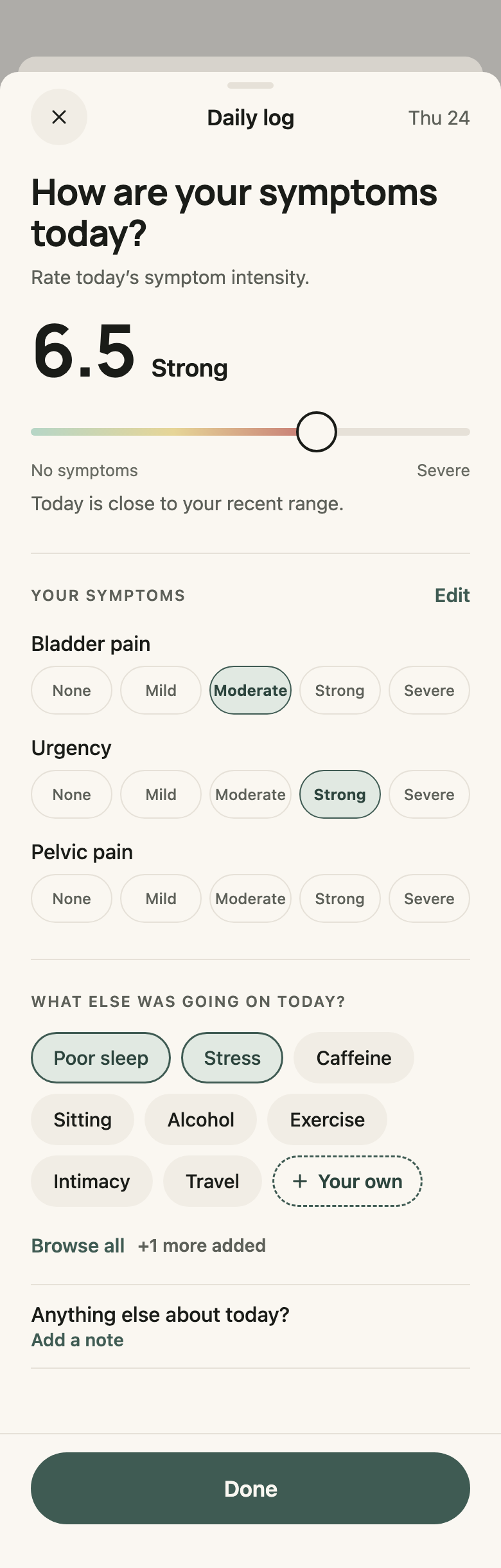
Noticing is different. A tracker that notices asks what was different today from two days ago. It keeps the context around a flare so you can see what the day before looked like. It holds onto the input, the sleep, the stress, the long sitting stretch, alongside the symptom, so the pattern can eventually emerge.
What the record needs to keep.
The most useful information in a pelvic or urinary symptom record is not just the symptom itself. It is what the body was doing in the 24 to 48 hours before. Sleep duration and quality. Stress level. Physical activity and prolonged sitting. Recent travel or schedule disruption.
These inputs do not explain symptoms in a simple one-to-one way. But they help describe the context around days when symptoms got worse or eased. Keeping them in the record alongside the symptom reading is what makes it possible to see the pattern instead of just the problem.
What a useful tracker leaves alone.
A tracker that demands too much breaks under the weight of the logging. If you are in pain, rushed, or just tired, you will not work through a 20-field check-in. The record will go incomplete. The context will drop out. And the pattern the tool was supposed to surface will disappear.
Good symptom tracking is structured but minimal. A daily check-in under a minute, capturing the most useful inputs consistently, is more useful than a detailed form that gets abandoned after three weeks. Brevity keeps the record alive, and a consistent record is the only kind that shows you anything.
Structure is what turns data into something you can use.
A page of notes is data. A structured symptom log, one that captures the same inputs in the same order every day, is something you can reason about. You can look back across two weeks and see the same combination appearing before every hard stretch. You can bring it into an appointment and point to it.
That structure does not have to be complex. It just has to be consistent, and it has to include the context around the symptom, not just the symptom itself.
Why this matters
The symptom trackers that actually help are not the ones that capture everything. They are the ones that are disciplined about what they ask for, consistent about how they ask for it, and honest about what the record shows.
What Intero is trying to build is a tracker that notices the right things, not the most things. That means being selective about what goes into the log, and being clear about what the log can and cannot tell you.
Common questions
- What makes a symptom tracker actually useful?
- A useful tracker notices the right signals rather than collecting everything. It keeps symptoms, context, sequence, and baseline together so the record can show a pattern.
- Do useful symptom trackers need to record everything?
- No. The value is not in recording every possible detail. It is in keeping the details that help explain what changed and what changed before symptoms got worse.
- Why is context important in symptom tracking?
- Context like sleep, stress, sitting, activity, or recent routine changes helps the record explain symptoms instead of just storing them as isolated entries.
- What should a good symptom tracker leave out?
- It should leave out noise that does not improve understanding. A tracker becomes more useful when it is selective enough to preserve the signal instead of overwhelming the user.
Sources