Evidence
What makes a record useful in appointments.
A pile of entries is not a useful record. What holds up in an appointment is something more specific: a sequence, some context, and a pattern that can survive a ten-minute conversation.
By Intero · Updated June 15, 2026 · 7 min read
Intero is observational, not diagnostic. Journal content is informational only and is not medical advice.
A pile of entries is not a useful record. What doctors need from a symptom history is sequence, context, and a pattern that holds up under questioning.
Most people who start tracking their pelvic or urinary symptoms have an appointment in mind, or a past appointment that went badly because they could not explain what was happening. The tracking is preparation. It is an attempt to arrive with something concrete.
But arriving with scattered notes is not the same as arriving with a useful record. What doctors can work with is a pattern, not a log. And patterns require structure that most people's tracking does not provide.
Keep a symptom history with Intero
Start with a daily entry, then build a record you can return to.
- Record symptoms and context.
- Review your history over time.
- Prepare a summary for appointments.
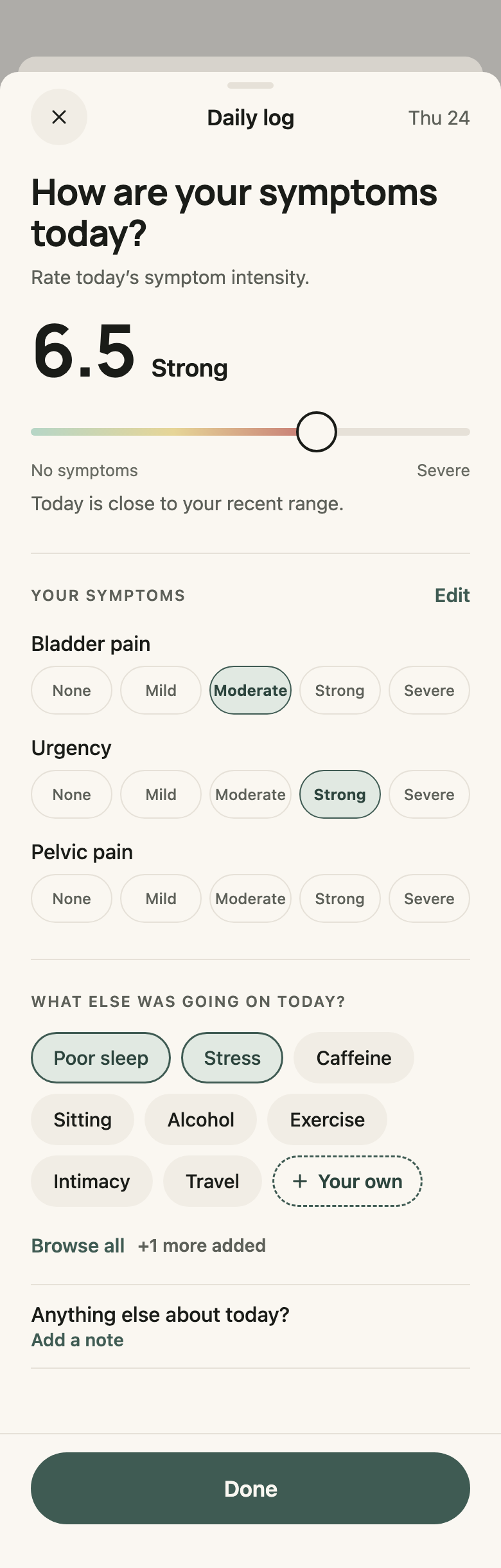

What a doctor actually needs from a symptom history.
A clinician assessing pelvic or urinary symptoms is trying to answer a small number of questions: How long has this been happening? What does a typical bad day look like compared to a typical manageable day? Are there things that reliably make it worse? Has anything changed recently?
Answering those questions requires a baseline, a pattern, and some context about what surrounds the rougher stretches. It does not require every entry from every day. It requires the right structure across enough days to show what is consistent.
The sequence is what makes the record useful.
The most useful thing a symptom record can bring into an appointment is not a severity score. It is a sequence. Two or three examples of the same thing happening in the same order, sleep dropped, stress elevated, two days later a flare arrived, are more persuasive than a hundred individual entries.
Sequences help make the record easier to talk through. They make it possible to say: this keeps showing up in the same order, and here is what my record looks like when it does.
What most symptom records cannot provide.
A notes app has no structure. Each entry exists in isolation. There is no way to see whether the two hard weeks in March looked like the two hard weeks in January. There is no consistent format, no way to extract a baseline, no comparison across time.
A spreadsheet is better, but it puts all the analytical work on the user. Most people are not going to build pivot tables before an appointment. And if the format changes from month to month, the comparison breaks anyway.
What a useful record needs is consistent structure from the first day, so that when you sit down before an appointment, the pattern is already in the data. You just need to describe it.
What to bring and what to leave out.
When preparing for an appointment, you do not need to bring everything. Three clear examples of a repeating pattern are worth more than thirty entries that do not form one.
Focus on what is consistent. What happened before a flare. What a manageable week looks like compared to a rough one. Whether anything has shifted recently, either for better or worse. If the record has structure, pulling this together should take ten minutes, not three hours.
Why this matters
A symptom record that is useful in appointments does not have to be exhaustive. It has to be organized well enough that you can point to a pattern and say: this is what keeps happening, and here is what it looks like when it does.
The tracking is not for the doctor. It is for you, to have language for your own experience. The appointment is where that language gets used. A good record makes the translation easier.
Common questions
- What makes a symptom record useful in appointments?
- A useful record has structure. It shows baseline, context, and repeating sequence so you can point to a pattern instead of handing over scattered notes.
- What do doctors actually need from a symptom history?
- Doctors usually need to understand what an ordinary day looks like, what a hard day looks like, what changed before flares, and whether anything has changed over time.
- Why is sequence more useful than just severity scores?
- Sequence is what makes the pattern persuasive. Two or three examples of the same order of events can tell a doctor much more than a list of isolated numbers.
- What should you bring to an appointment from your symptom record?
- Bring a few clear examples of a repeating pattern, including what tended to happen before a flare and how a manageable week compared with a hard one.
Sources