Practical guide
How to track symptoms for your doctor.
Most symptom logs are not useful in appointments. Not because the tracking was not thorough, but because the format does not produce the kind of information a doctor can work with.
By Intero · Updated June 15, 2026 · 8 min read
Intero is observational, not diagnostic. Journal content is informational only and is not medical advice.
What doctors need from a symptom record is not a list of bad days. It is context, sequence, and a pattern that can survive a ten-minute appointment.
Tracking symptoms for a doctor appointment feels like it should be straightforward. Write down what happened, when it happened, how bad it was. Show up with the notes. But most people who have tried this know that it does not quite work that way in practice.
The problem is not volume. You can arrive with three months of daily entries and still struggle to answer the questions you are asked. What does a typical bad day look like? What seems to make it worse? Has anything changed recently? Those questions require structure that most symptom logs do not have.
Keep a symptom history with Intero
Start with a daily entry, then build a record you can return to.
- Record symptoms and context.
- Review your history over time.
- Prepare a summary for appointments.

What your doctor actually needs.
A clinician working with pelvic or urinary symptoms is trying to build a picture of your baseline, your pattern, and your trajectory. Baseline: what does ordinary look and feel like for you, separate from the rougher stretches? Pattern: what happened before or after a flare? Trajectory: is this getting better, worse, or staying the same over the past few months?
These are the questions that shape an appointment conversation. A useful symptom record helps answer them more clearly, without leaving the clinician to sort through a list of isolated entries.
The sequence matters more than the severity.
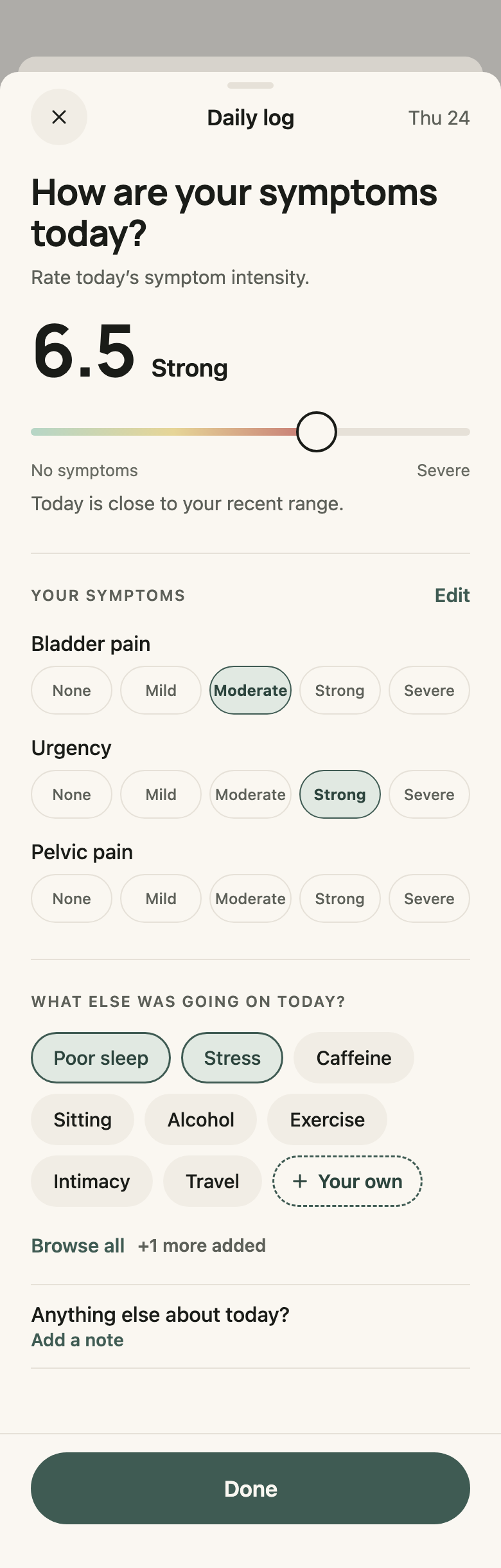
One of the most useful things you can bring to an appointment is a clear example of the sequence that precedes a flare. Not a single entry, but two or three days of context: sleep dropped, stress was elevated, then two days later symptoms were significantly worse.
When that same sequence appears more than once in the record, it is no longer anecdote. It is a pattern. That pattern gives you clearer language for the appointment and gives the clinician a better sense of what your own record has been showing over time.
The severity score on the day of the flare is useful context. But without the sequence before it, the score floats alone. The doctor knows something was hard but not what made it hard.
Context your doctor cannot see.
A doctor appointment gives your clinician a ten-to-twenty minute window into a chronic condition that shapes your daily life. They are not going to know what the last three months felt like from a brief exchange. The record closes that gap.
The context that matters most, and that your doctor cannot observe directly, is what your ordinary range looks like, what your days when symptoms got worse look like in comparison, and what changes around the transitions between them. Sleep, stress, activity, recent schedule disruptions. These are not in your chart. They are in your record.
A useful symptom log makes the invisible visible: the pattern your body has been showing you, in a form that can survive a ten-minute appointment.
What a useful symptom record needs to contain.
For pelvic and urinary symptoms, the most useful daily tracking inputs are: a symptom level (pressure, urgency, burning, whatever your relevant symptoms are), sleep duration and quality, stress level, and any significant departures from routine such as travel, prolonged sitting, or dietary changes.
You do not need every detail every day. You need consistency over enough time to build a baseline and surface a pattern. Four to six weeks of structured logging is usually enough to see something meaningful, provided the format is consistent throughout.
The preparation for an appointment is straightforward: look for the two or three times in the record where a flare followed the same combination of inputs. That is the pattern. That is what you bring.
Why this matters
Tracking for an appointment is not a demonstration of thoroughness. It is preparation, and arriving with a clear answer to the questions you will be asked requires structure, not just volume.
A symptom record that has a baseline, a pattern, and a sequence is worth more in an appointment than three months of unstructured notes. The structure is what makes the information usable.
Common questions
- How should you track symptoms for a doctor appointment?
- Track symptoms in a format that shows baseline, context, and sequence. The goal is not to collect the most entries, but to make the pattern visible and explainable.
- What does your doctor actually need from a symptom log?
- Your doctor usually needs to understand your ordinary range, what happens before symptoms got worse, and whether anything has shifted over time.
- What kinds of context are useful to track for pelvic or urinary symptoms?
- Useful context often includes sleep, stress, activity, prolonged sitting, and major departures from routine that appeared around symptom changes.
- How much symptom data do you need before an appointment?
- Four to six weeks of consistent structured tracking is often enough to surface a meaningful pattern, provided the format stays consistent.
Sources