Observation
Why good days matter too.
A baseline needs the quiet days as much as the hard ones. Without them, a symptom record can only tell you that something got worse, not what normal actually looks like.
By Intero · Updated June 15, 2026 · 6 min read
Intero is observational, not diagnostic. Journal content is informational only and is not medical advice.
A symptom baseline only holds up when it includes the quiet days. Here is why logging good days is just as important as logging flares.
Most people start tracking because something is wrong. The first entries are almost always bad days, high-pressure mornings, unexplained urgency, a week that will not settle down. That makes sense. The hard days are the ones that prompt the question.
But a record built only from hard days cannot answer the question it is being asked. To know what changed, you need to know what you are measuring from. That is what the quiet days provide.
Keep a symptom history with Intero
Start with a daily entry, then build a record you can return to.
- Record symptoms and context.
- Review your history over time.
- Prepare a summary for appointments.
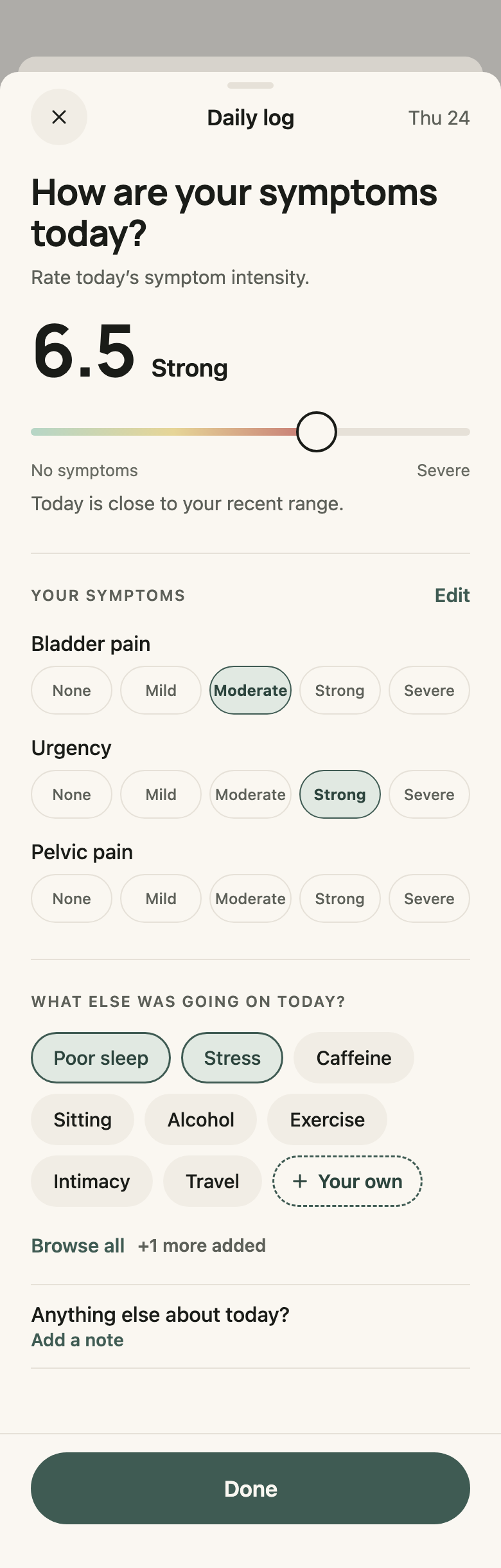

A baseline is what everything else gets measured against.
Before a pattern can be identified, there has to be a reference point. That reference point is the baseline, the body's ordinary range on a day that is not remarkable in either direction.
Without it, there is no way to distinguish a flare from a slightly harder-than-usual stretch. There is no way to tell whether sleep is helping or whether symptoms are improving or simply fluctuating within a normal range that you have not measured yet.
Good days are not the absence of data.
It can feel like a low-symptom day does not need to be logged. Nothing unusual happened. Nothing to report. But that is the wrong frame for what a useful record actually requires.
A good day is data about your ordinary floor. It tells the record what a manageable morning looks like, what level of pressure is unremarkable for you, what sleep and stress and activity add up to when nothing is going wrong. Without it, the hard days have nothing to compare against.
The symptom record that only contains hard days will never know whether this week is worse than last month. It only knows it was worse than yesterday.
Patterns only become visible when both ends of the range are in the record.
Pelvic and urinary symptoms do not stay constant. They shift with sleep, stress, activity, hormonal rhythms, travel, and dozens of other inputs that matter differently for different people. The range itself is part of the picture.
When the record contains both quieter and rougher days, it becomes possible to see what the transition tends to look like. What comes right before a flare. What follows a stretch of good sleep. Whether the recovery after a hard stretch follows a pattern.
That kind of comparison is only possible when both sides are logged.
The baseline takes time to build, but it builds from the first entry.
In the early weeks of tracking, the baseline is still forming. There is not yet enough data to distinguish ordinary variation from a meaningful shift. That is expected.
But every quiet day that goes into the record is contributing. The baseline gets more reliable as the quiet days accumulate alongside the rougher ones. By the time a flare arrives, there is something to compare it to, not just a feeling, but a number, a sequence, a shape.
Why this matters
A symptom record built only from hard days gives you a list of problems. A record that also includes the quiet days gives you a baseline, and a baseline is what makes it possible to see a pattern instead of just a pile of bad moments.
Logging the ordinary days is not busywork. It is the work. Without those days in the record, the hard days have nothing to be compared to.
Common questions
- Why should you log good days in a symptom tracker?
- Good days help build a baseline. Without them, the record can tell you that something got worse, but not what ordinary or manageable actually looks like.
- What is a symptom baseline?
- A symptom baseline is your ordinary range on a day that is not remarkable in either direction. It is the reference point that makes flares and rougher stretches comparable.
- Are low-symptom days still useful data?
- Yes. Quiet days show what sleep, stress, activity, and symptom levels look like when nothing is obviously going wrong, which is essential for comparison.
- Can you find patterns if you only track bad days?
- Not very well. Patterns become clearer when the record contains both quieter and rougher days, because transitions only make sense when both ends of the range are present.
Sources