IC and pelvic health
What can show up before IC flares.
Interstitial cystitis flares rarely point to one simple explanation. Looking at what appeared in the days before a rougher stretch can change how you read your own symptoms.
By Intero · Updated June 15, 2026 · 9 min read
Intero is observational, not diagnostic. Journal content is informational only and is not medical advice.
Interstitial cystitis flares rarely point to one simple cause. A record can show what appeared before symptoms got worse.
One of the most disorienting things about interstitial cystitis is that flares can seem to come from nowhere. One day is manageable. Two days later, pressure is high, urgency is elevated, and the same life that was fine on Monday is now hard to get through.
The explanation is usually not that nothing happened. It is that the useful context was not obvious, or that it showed up earlier than the flare itself. IC flares rarely line up with one isolated input in the same hour. More often, several pieces of context accumulate across time.
Keep a symptom history with Intero
Start with a daily entry, then build a record you can return to.
- Record symptoms and context.
- Review your history over time.
- Prepare a summary for appointments.
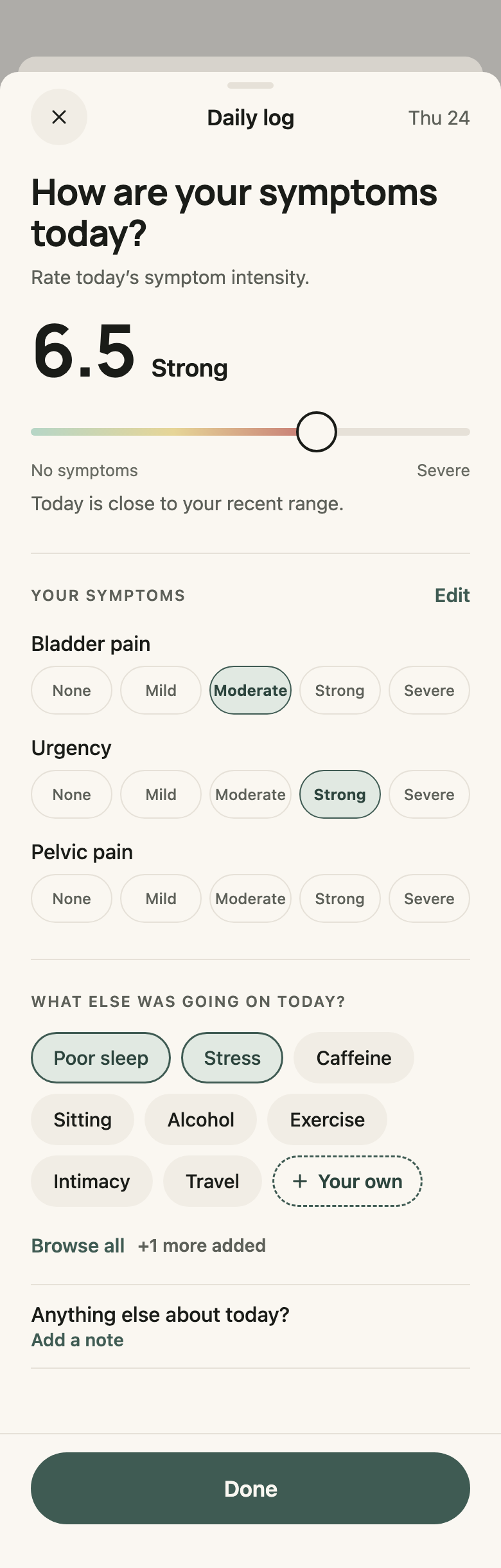

IC flares rarely point to one single thing.
The search for a single trigger is a natural response to a flare. What did I eat? What did I drink? What was different today? But for most people with IC, the honest answer is that one isolated input rarely explains the whole picture on its own.
What can show up instead is a combination: reduced sleep alongside elevated stress, a long day of sitting after a period of low movement, a dietary input that may land differently on a depleted week than on a steadier one. The individual pieces are often unremarkable on their own. It is the combination, close together in time, that is worth noticing in the record.
The inputs that can appear before IC symptoms worsen.
Research on interstitial cystitis and clinical observation both point to a cluster of inputs that appear frequently before symptom escalations: sleep disruption, elevated psychological stress, prolonged sitting or physical inactivity, dietary factors (particularly acidic foods, caffeine, and alcohol in susceptible individuals), and changes to routine such as travel or schedule disruption.
Not all of these are relevant for every person with IC. The patterns are individual. But across many people, these categories come up repeatedly, and their significance often lies not in any single one of them but in how they combine.
Two nights of shortened sleep may not mean much on their own. Two nights of shortened sleep during a high-stress work period, following a long drive, may be more worth noticing. The record is what makes it possible to see whether that combination keeps showing up before your symptoms got worse.
The accumulation effect.
IC symptoms often respond to accumulation rather than acute events. A single stressor, a single disruption, or a single dietary choice might be well within the range of what your body manages without incident. But when they stack within a short enough period, the cumulative load can exceed what your bladder and pelvic floor are managing quietly.
This is one reason flares can seem to appear with a delay. The accumulation is happening over one or two days. The flare arrives when it peaks, which might be 24 to 48 hours after the first input that contributed to it.
The lag between context and flare is one reason the pattern can be hard to read in the moment. The record makes that lag easier to see by keeping the days before the flare alongside the symptom reading itself.
What the record can show.
Seeing your personal IC flare pattern requires time and consistent logging. Not because the pattern is hidden, but because it only becomes visible when you have enough data to see what changed before symptoms got worse.
A useful record for IC includes daily symptom level, sleep quality and duration, stress level, prolonged sitting, and any major dietary or schedule departures. With that data across four to six weeks, patterns often start to emerge: the same combination appearing before multiple hard stretches, or a baseline that looks steadier under certain conditions.
Certainty about one simple explanation is probably not coming. What tracking builds instead is enough structure to walk into an appointment and describe what your body has been showing you in grounded, specific language.
Why this matters
IC flares are hard to explain in the moment because the most useful context is rarely in the same moment. The useful information is usually in the 24 to 48 hours before: the sleep that was short, the stress that was elevated, the sitting that went on too long.
A symptom record that captures context alongside symptoms is how you eventually stop guessing. Not because the patterns become simple, but because they become visible.
Common questions
- What causes IC flares?
- IC flares rarely point to one single explanation. They often reflect several inputs accumulating across sleep, stress, sitting, diet, or routine changes over the previous one to two days.
- Do IC flares usually have one trigger?
- For many people, no. A flare is more often tied to a combination of factors than to one isolated trigger in the same hour symptoms worsen.
- Can stress or poor sleep affect IC flares?
- Yes. Reduced sleep and elevated stress are two of the inputs that commonly appear before IC symptoms worsen, especially when they combine with other strain on the body.
- Why do IC symptoms sometimes show up a day later?
- IC symptoms often follow an accumulation pattern. The contributing inputs can build over 24 to 48 hours, and the symptoms that feel worse show up after that load crosses a threshold.
Sources