Signal
What to watch when mornings feel worse than nights.
If pelvic or urinary symptoms are reliably worse in the morning, the clue is usually not in how the morning went. It is in how the day before ended.
By Intero · Updated June 15, 2026 · 6 min read
Intero is observational, not diagnostic. Journal content is informational only and is not medical advice.
Morning pelvic symptoms are often yesterdays story. Understanding what accumulates overnight can change how you read rougher starts to the day.
Waking up to a high-pressure morning feels immediate. The symptoms are right there, present from the first minutes of the day, before anything in the morning seems to explain them. It is easy to look at the morning and try to locate the answer there.
But the morning is often a delayed reading of something that happened earlier. Sleep quality, evening stress, and how much you were sitting in the hours before bed do not always show up in the same session. Sometimes they show up the next morning instead.
Keep a symptom history with Intero
Start with a daily entry, then build a record you can return to.
- Record symptoms and context.
- Review your history over time.
- Prepare a summary for appointments.
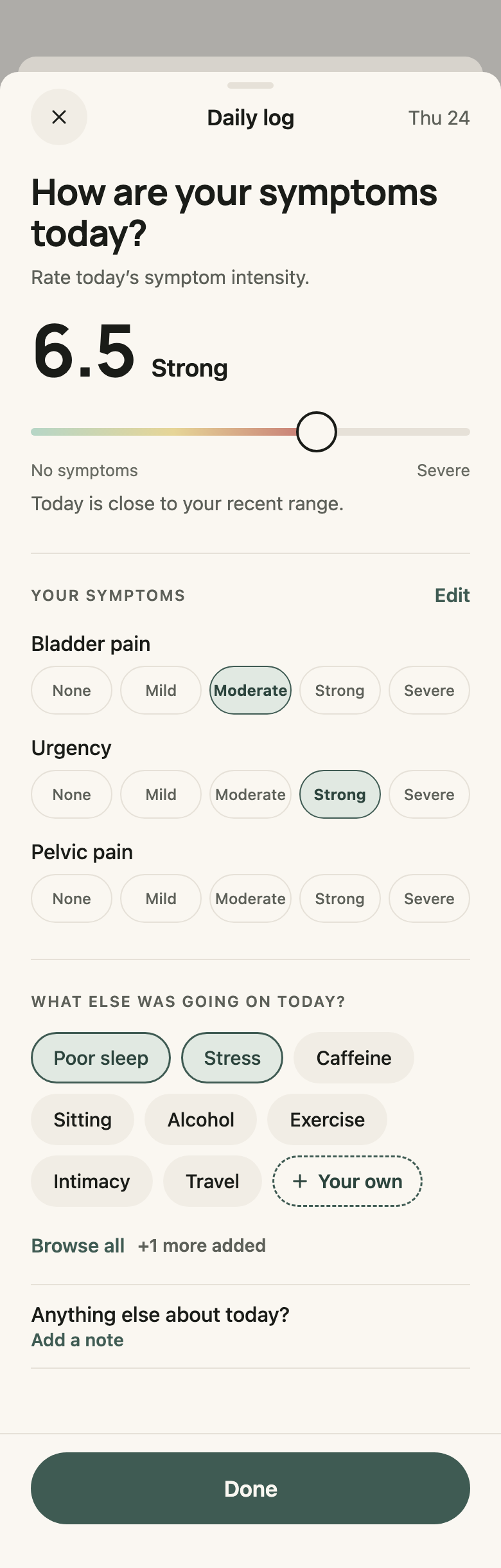

The morning reading is often a yesterday story.
Pelvic and urinary symptoms do not reset at midnight. What happened in the twelve to eighteen hours before waking is still in the system. Tension that built through a long day of sitting. A difficult evening that kept stress elevated. Poor sleep that prevented whatever partial recovery was possible.
When symptoms are consistently worse in the morning, this is one of the first places to look, not at the morning itself, but at what led into it. The timing of when symptoms show up is a clue about when they were set in motion.
Sleep is one of the most important inputs.
Sleep duration and quality can appear in patterns associated with rougher pelvic and urinary symptom days. Not because sleep explains everything, but because the overnight period is a meaningful part of the surrounding context, and when that window is cut short or disrupted, the next day often reflects it.
Tracking sleep alongside symptoms is not about proving that sleep causes flares. It is about having the data to see whether shorter or more fragmented sleep can appear before rougher stretches for you, specifically. The relationship varies between people. The only way to know whether it is a factor in your pattern is to have both in the record.
Evening patterns matter more than they seem.
What happened in the evening before a difficult morning is worth examining. Long sitting. Elevated stress without any way to release it. A later dinner. Screen time that pushed bedtime back. None of these are obviously medical. But they are the kinds of inputs that stack.
Pelvic and urinary symptoms often respond to accumulations, not single events. An evening that was fine, but which followed two already-tiring days, can still tip the balance. The morning is where the tipping shows up.
What to capture when mornings are reliably worse.
If mornings are the pattern, if that is when you consistently feel worst, then the most useful thing to track is the evening before and the night itself. How long you slept. How rested you felt when you woke. What stress looked like in the hours before bed. Whether you were sitting for a long stretch in the late afternoon or evening.
You do not need all of this every day. You need enough of it consistently to see whether a sequence is forming. When the same combination appears before the same kind of morning more than twice, the record starts to show you something real.
Why this matters
The mornings that feel worst are often the hardest ones to reason about because they arrive before the day has given you anything to blame. But if the record has the evening before and the night's sleep in it, the picture usually gets clearer.
Symptom tracking that only looks at the moment the symptom appears will miss the sequences that explain it. The useful clue often sits one chapter back.
Common questions
- Why can pelvic symptoms feel worse in the morning?
- Morning symptoms are often a delayed reading of what happened earlier, especially the evening before and the quality of the night's sleep.
- Can sleep affect morning pelvic or urinary symptoms?
- Yes. Sleep duration and sleep quality often appear in patterns linked to rougher symptom days because the overnight period is an important recovery window.
- What should you track if mornings are consistently worse?
- Track the evening before and the night itself, including sleep, stress before bed, and whether you spent long stretches sitting late in the day.
- Are morning symptoms always tied to something that happened that morning?
- Often no. The timing can be a clue that the more useful explanation sits in the previous day rather than in the first hour after waking.
Sources