IC and pelvic health
Looking for a BladderTracker alternative.
BladderTracker is no longer available on the App Store. If you were using it to track IC or pelvic symptoms, here is what to look for in a replacement, and why the record you keep matters more than the app you keep it in.
By Intero · Updated June 15, 2026 · 7 min read
Intero is observational, not diagnostic. Journal content is informational only and is not medical advice.
BladderTracker is no longer on the App Store. Here is what to look for in an IC symptom tracker replacement.
BladderTracker was one of the few apps built specifically for interstitial cystitis symptom tracking. For many people with IC, it was the first tool that felt like it understood what they were actually trying to measure. Its removal from the App Store in early 2026 left a gap that generic health or hydration apps are poorly equipped to fill.
If you are looking for a BladderTracker alternative, the most important thing is not finding a replacement that looks the same. It is finding one that tracks the right things, the context around symptoms, not just the symptoms themselves.
Keep a symptom history with Intero
Start with a daily entry, then build a record you can return to.
- Record symptoms and context.
- Review your history over time.
- Prepare a summary for appointments.
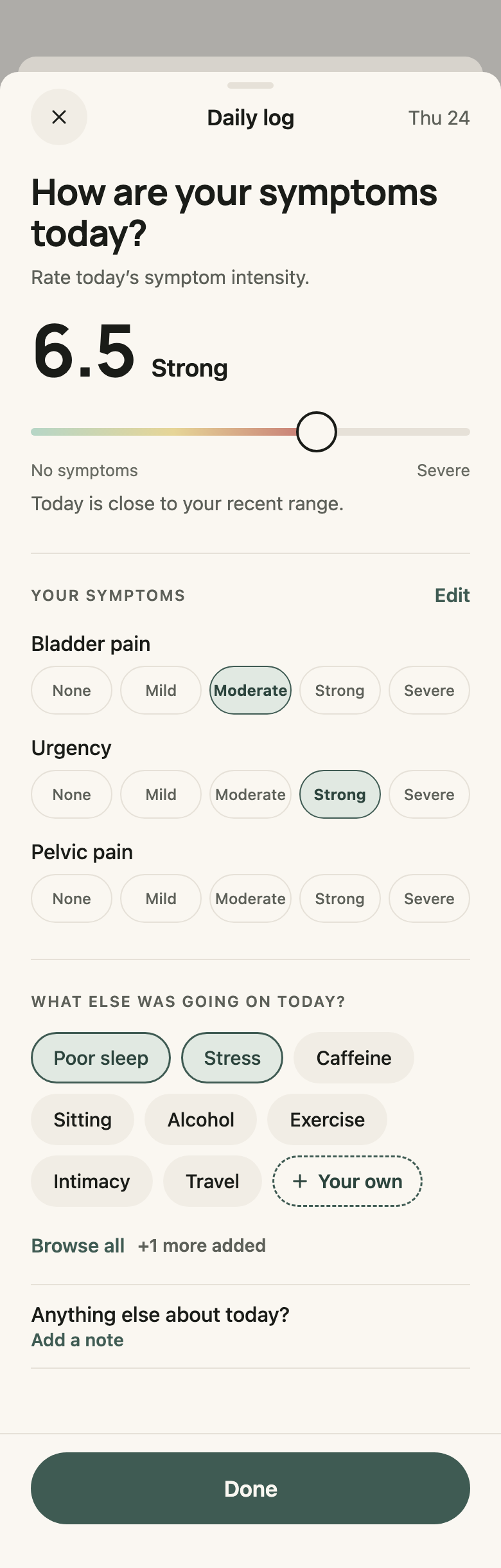

What made BladderTracker worth using.
BladderTracker was useful because it was specific. It was built for bladder symptoms, which meant its input fields matched what IC patients actually needed to record: urgency, pain levels, bathroom frequency, and the factors that can accompany days when symptoms got worse.
Generic symptom trackers or hydration apps require users to work against the tool by creating custom fields, adjusting categories, and interpreting outputs designed for a different condition. The specificity of BladderTracker reduced the cognitive overhead of logging, which made it more likely that people would actually keep using it through a difficult stretch.
That specificity is what to look for in a replacement. The app should understand IC and pelvic health as the primary use case, not as a custom configuration of a generic template.
What a useful IC tracking app actually needs to capture.
For interstitial cystitis, the most clinically useful symptom record captures more than urgency counts. It captures the conditions around the symptom, including sleep quality, stress level, dietary inputs, activity, and the day-to-day baseline that tells you whether Tuesday was actually worse than last week or just felt that way.
This matters because IC flares rarely point to one simple explanation in the same hour. They tend to reflect several inputs accumulating over one to two days. An app that records symptoms without recording context leaves you with data that looks complete but cannot explain what it is showing you.
The record that holds up in a doctor appointment is the one that can answer: what was happening in the two days before your hardest day this month? If your tracking app cannot help you answer that question, it is missing the most useful layer.
The lag problem most IC apps do not solve.
One of the most disorienting things about IC is that the earlier context and the symptom are often not in the same day. A stressful Wednesday and a short night of sleep on Thursday might not line up with elevated symptoms until Friday or Saturday. If you only record how you feel on the bad day, you miss the context that came before it.
A useful BladderTracker alternative needs to make it easy to log conditions every day, not just on hard ones. The record only becomes useful for pattern recognition when it includes the full stretch, quiet days alongside flares, so that you can eventually see what appears in the days before symptoms escalate.
This is also what makes the record useful to a doctor or pelvic floor specialist. Not a list of bad days, but a picture of the whole period: what was stable, what changed, and what days when symptoms got worse followed.
What to look for in a replacement.
The most important criteria for a BladderTracker alternative are: IC-specific symptom fields rather than generic ones; event logging (sleep, stress, activity, diet) alongside symptom severity; a daily check-in format that is fast enough to sustain through a difficult month; and a way to view patterns over time rather than only seeing individual entries.
Privacy is also worth considering. Health data of this specificity is sensitive. An app that syncs to third-party services, sells aggregated data, or requires an account to use is trading your most private health information for convenience features you may not need.
Intero was built specifically for this use case: pelvic and urinary symptoms, tracked with enough context to be useful, with all data stored privately on-device. It is available on iPhone and does not require an account.
Why this matters
The app matters less than the record. What you are trying to build is a holistic picture of your symptoms and the conditions around them, one that you can hand to a doctor and say: here is what my body has been showing me.
A good replacement for BladderTracker is one that makes that record easy to keep, specific enough to be useful, and private enough to be trusted. The interface matters far less than whether the record it produces actually helps.
Common questions
- What should you look for in a BladderTracker alternative?
- Look for an app that is specific enough for IC or pelvic symptoms, captures context alongside symptoms, and helps you see patterns over time rather than isolated entries.
- Why was BladderTracker useful for many IC patients?
- It was useful because it was specific to bladder symptoms, which reduced logging friction and matched what many IC patients were actually trying to record.
- Do generic symptom trackers work well for IC?
- Often not. Generic trackers may store entries, but they usually do not capture the condition-specific context or sequence that makes an IC record useful.
- Why does privacy matter in an IC tracking app?
- Health data this specific is sensitive. A good replacement should be private enough to trust and not require unnecessary sharing just to keep a useful record.
Sources