IC and pelvic health
Why caffeine affects the bladder — and why water doesn't fix it.
Caffeine is one of the most frequently reported dietary factors for people with bladder conditions. The standard explanation — that it dehydrates you — misses what the bladder is actually responding to.
By Intero · Updated June 15, 2026 · 8 min read
Intero is observational, not diagnostic. Journal content is informational only and is not medical advice.
Caffeine acts on the bladder wall's smooth muscle directly, not just through dehydration. That's why drinking more water doesn't always help — and why the response often arrives the next day.
The experience is common. Someone with interstitial cystitis or overactive bladder cuts out coffee and notices nothing for a week. Or they keep drinking it and feel fine most of the time, then have a hard day that looks indistinguishable from any other. Caffeine has a reputation as a bladder problem, but the connection is harder to see than the reputation suggests.
Part of the reason is that the explanation most people get is incomplete. Caffeine dehydrates you, which puts more strain on the bladder. Drink more water alongside it and the effect should cancel out. For some people with bladder conditions, that logic holds. For many others, it doesn't — and the reason has less to do with fluid volume than with how caffeine interacts with the bladder wall directly.
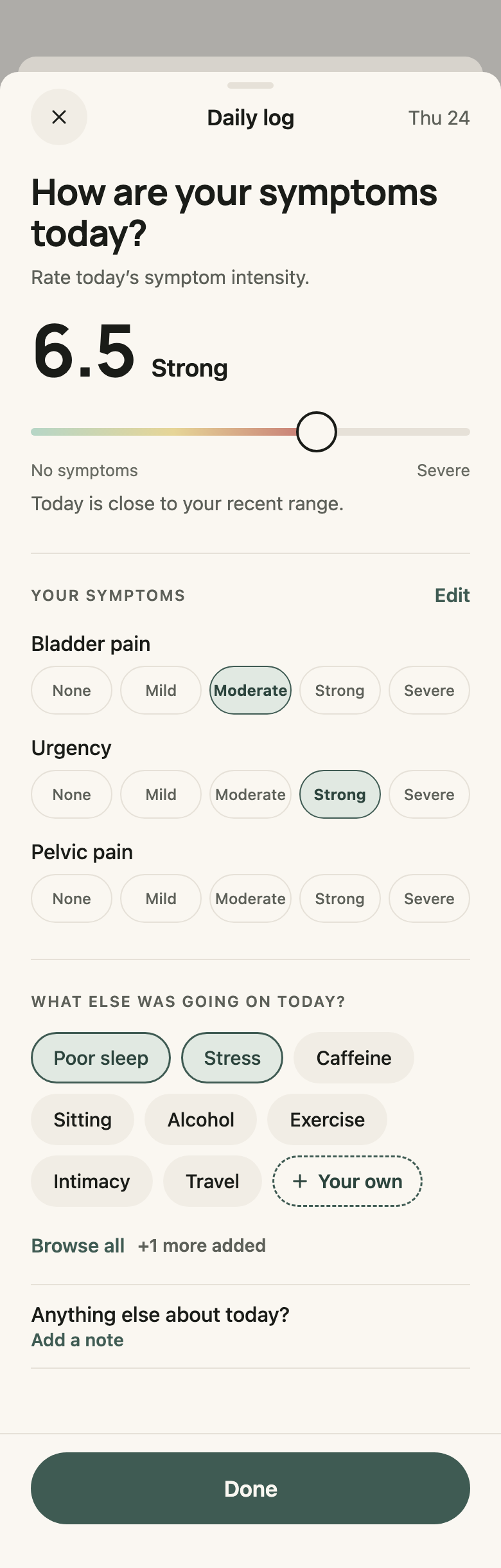
Keep a symptom history with Intero
Start with a daily entry, then build a record you can return to.
- Record symptoms and context.
- Review your history over time.
- Prepare a summary for appointments.

The dehydration explanation is only part of the picture
Caffeine is a mild diuretic. It increases urine production, which means the bladder fills faster and the urge to urinate arrives sooner. This is real, and for a healthy bladder it might be the whole story.
For a bladder that is already reactive — as in interstitial cystitis or overactive bladder — there is a second mechanism at work, and it operates independently of how much fluid is in the system. Drinking extra water alongside caffeine addresses the diuretic side. It does not address the direct effect on the bladder wall.
The dehydration framing is not wrong so much as it is incomplete. It explains why caffeine increases frequency in healthy people. It does not explain why someone with IC can drink plenty of water alongside their coffee and still feel urgency or pressure an hour later, or why that same person might drink two cups on a good day with no reaction at all.
Caffeine acts on the bladder's smooth muscle directly
The bladder wall contains a smooth muscle layer called the detrusor. It is what contracts when you urinate and what creates the sensation of urgency when it contracts before the bladder is full. Caffeine affects this muscle directly by promoting the release of intracellular calcium within those cells. More calcium means more contractility — the muscle becomes more prone to involuntary or premature contractions.
The result is urgency that does not come from a full bladder. The sensation is real; the bladder just hasn't reached the point where it normally would signal. For someone whose detrusor is already reactive, this additional stimulus adds to a load that may already be close to threshold.
This is also why the response can look like a flare even when nothing else changed. The caffeine is not irritating the bladder through what it does to urine. It is stimulating the muscle wall directly. Water does not buffer that.
The timing makes the connection hard to see
Even once the mechanism is understood, the timing of the response creates its own problem. The standard way people check whether something affects their symptoms is to note how they feel the same day. For caffeine and bladder conditions, that window is often too narrow.
Caffeine's direct effects on smooth muscle do not resolve the moment it leaves the bloodstream. Research on bladder diary analysis has found the same thing: a 2023 NIH-funded study that tracked individual intake and symptom patterns found that the time-lag between what a person consumes and how their bladder responds is not straightforward enough for same-day comparison to capture reliably.
The practical result: someone who tracked caffeine for a week and concluded there was no pattern may have been measuring on the wrong day. The symptoms that feel worse arrived the following morning, or later that evening, and got attributed to something else. This is not a failure of attention. It is a structural problem with same-day logging for conditions that respond on a longer delay.
Individual responses vary — only a personal record can settle this
The research has an honest finding worth naming. A 2011 double-blind, placebo-controlled trial found no statistically significant difference in symptoms between IC patients given caffeine and those given a placebo. That result does not mean caffeine is irrelevant. It means individual responses vary enough that the effect disappears at the population level. Some people have a clear and consistent reaction. Others have none. Both are accurate descriptions of real people.
This is why the question of whether caffeine affects a specific bladder cannot be answered by population data or by a few days of observation. A longer record — tracking caffeine alongside daily symptom level, and looking at what the following day looked like, across four to six weeks — gives you enough data to see whether a pattern is actually there.
If caffeine repeatedly shows up in the day or two before days when symptoms got worse, that is the connection showing itself. If it doesn't, that is real information too. The record is the only way to stop guessing either way.
Why this matters
Caffeine is one of the most frequently discussed dietary factors in bladder conditions, but the standard explanation — that it dehydrates you — misses the direct effect on the bladder wall. Drinking more water does not address that. Neither does cutting caffeine for a few days and seeing no obvious change, when the response can arrive the following day.
A symptom record that tracks caffeine alongside what the following day looked like makes the connection visible if it exists. Four to six weeks of consistent logging is usually enough to see whether caffeine appears repeatedly before symptoms got worse — or to confirm it does not.
Common questions
- Does caffeine irritate the bladder?
- For many people with bladder conditions like interstitial cystitis or overactive bladder, caffeine is one of the most frequently reported dietary factors that shows up before days when symptoms got worse. It acts on the smooth muscle of the bladder wall directly, not only through its diuretic effect, which is why drinking more water does not always prevent the reaction.
- Why doesn't drinking more water cancel out caffeine's effect on the bladder?
- The diuretic effect of caffeine — increased urine production — is one mechanism. But caffeine also acts directly on the detrusor muscle of the bladder wall, making involuntary contractions more likely and driving urgency that has nothing to do with how full the bladder is. That effect is not reduced by adding more fluid. The two mechanisms are separate.
- How long after drinking caffeine can bladder symptoms appear?
- The response does not always arrive the same day. Research on bladder diary patterns has found that the time-lag between intake and bladder response is not straightforward, and symptoms can appear hours later or the following day. Same-day tracking often misses the connection for this reason.
- How do I know if caffeine is affecting my bladder symptoms?
- A few days of observation is usually not enough because the response can arrive the next day rather than the same one. Tracking caffeine alongside your daily symptom level across four to six weeks — and looking at what the day after looked like, not just the same day — can make a personal pattern visible, or rule it out.
Sources
- Molecular Medicine Reports: Caffeine enhances micturition through neuronal activation in normal rats
- PMC / Neurourology and Urodynamics: Dynamic analysis of individual patterns of intakes, voids, and bladder sensations reported in bladder diaries — LURN Study
- NIDDK: Eating, Diet, & Nutrition for Interstitial Cystitis
- American Urological Association: Diagnosis and Treatment of Interstitial Cystitis/Bladder Pain Syndrome