Tracking and patterns
Tracking pelvic symptoms: what to record and why it matters.
Most symptom records stay incomplete — not because people log too little, but because they log the wrong things. Here is what a useful pelvic symptom record actually captures, and what it can show you over time.
By Intero · Updated June 15, 2026 · 9 min read
Intero is observational, not diagnostic. Journal content is informational only and is not medical advice.
Most symptom records stay incomplete — not because people log too little, but because they log the wrong things. Here is what a useful pelvic symptom record actually captures.
Most people start tracking when things are already bad. A difficult stretch, a worsening pattern, a doctor who asks how often it happens. The first instinct is to write down what hurts, how much, and how often. That record is honest. It captures something real. But it is thin.
The symptom alone — urgency at a 7, pressure high, twelve bathroom visits in a day — tells you the result. It does not tell you the setup. And for most pelvic and urinary conditions, the setup is where the pattern lives: the sleep that was short, the stressful week, the long stretch of sitting, the schedule that fell apart. Those things do not show up in a bare frequency count.
This is a guide to what goes in a useful record for tracking pelvic symptoms — not more fields, but the right ones — and what that record can show you over time.
Keep a symptom history with Intero
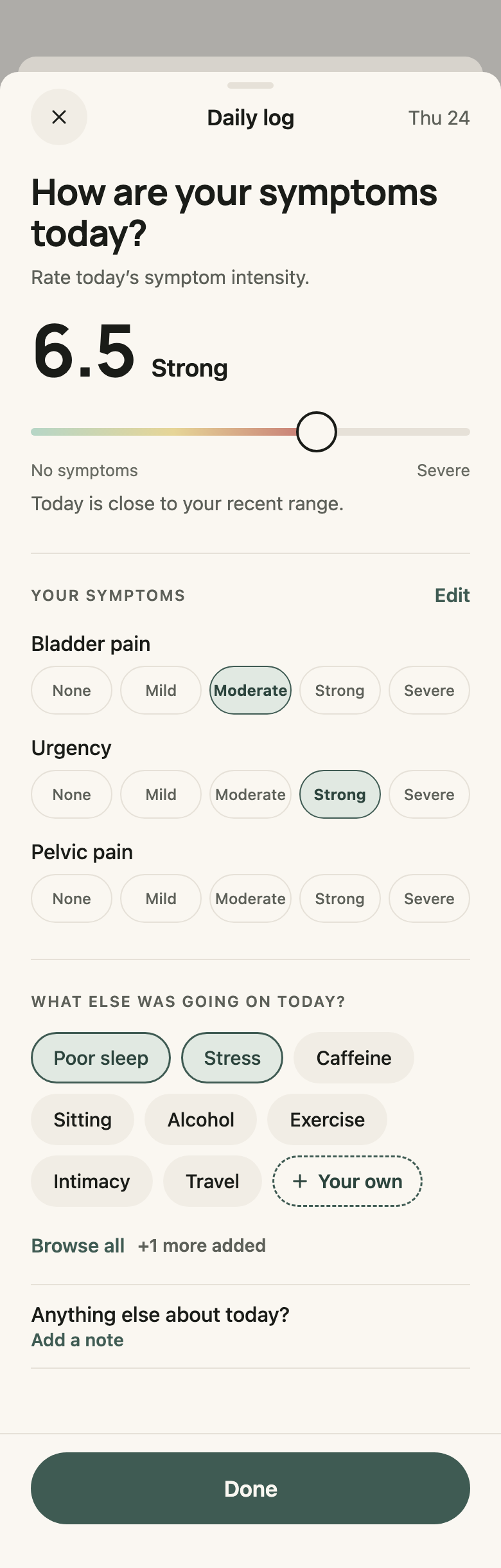
Start with a daily entry, then build a record you can return to.
- Record symptoms and context.
- Review your history over time.
- Prepare a summary for appointments.

Why tracking frequency alone is not enough
Counting how often you urinate or rating how much pain you feel on a given day is a reasonable place to start. But the hard question for most pelvic and urinary conditions is not "what is the number" — it is "why was today harder than three days ago?" A frequency count answers the first. It does not answer the second.
To answer the second, you need to know what was different in the day or two before: how you slept, how stressed you were, how long you sat, what you ate or drank, whether anything unusual disrupted your routine. Those are the inputs that appear before rougher stretches. Without capturing them alongside the symptom, the record is a log of outcomes with nothing attached to explain them.
This is not a failure of effort. It is a failure of structure. Most tracking approaches — a notes app, a paper diary, a generic symptom log — ask for the symptom but not the context. The record fills up with numbers and has nothing to say about why the numbers look the way they do.
What a useful pelvic symptom record captures
A consistent record for tracking pelvic symptoms does not need to be long. It needs to be the right shape. The inputs that tend to matter most, across conditions like IC, OAB, and CPPS, fall into a short list.
Symptom level is the obvious one — urgency, pressure, burning, pelvic pain, or frequency, depending on what your primary experience is. One honest daily rating is more useful than a detailed hourly log that most people abandon after ten days.
Sleep matters more than most people expect. How long you slept and how well you slept are two different things. Both appear before symptoms got worse often enough that seeing it in the record tends to be a surprise — especially because the connection is rarely obvious in real time. The symptoms show up hours or a full day later, not in the same moment the sleep was poor.
Stress level deserves its own field. A simple daily rating — low, moderate, high — is enough. Elevated stress and worse symptom days correlate often enough that seeing it in writing changes how you read a difficult week. It also changes what you tell a clinician: "the last two weeks were unusually stressful, and that is when things got harder" is specific in a way that "it has been a rough stretch" is not.
Physical activity and prolonged sitting both belong in the record. Long stretches of sitting without movement appear in the data before symptoms got worse for many people with pelvic floor conditions, IC, and CPPS. This is not always visible until the same pattern has shown up three or four times across several weeks.
Routine disruptions — travel, unusual schedule, disrupted meals — are easy to forget when reconstructing a week from memory. They are easy to capture in the moment, and they often help explain why a particular stretch looked different from the one before it.
Dietary departures are particularly relevant for IC, where acidic foods, caffeine, and alcohol are common in the patterns of people who have them as triggers. Not everyone has dietary triggers. But the record is often the only way to find that out, or to rule it out.
Why patterns in pelvic symptoms take weeks to become visible
The first week of logging is often unremarkable. The data is sparse. Nothing clear stands out. This is normal, and it is not a sign that the tracking is not working.
Pelvic and urinary conditions often work on a longer timescale than the symptom itself suggests. A rougher stretch that arrives on a Tuesday was often preceded by inputs from Sunday and Monday. Five days of data is not enough to see that. You need the same combination appearing before similar outcomes more than once — enough times that it looks like a pattern rather than coincidence.
Four to six weeks of consistent daily logging is usually the minimum before patterns start to repeat clearly. This is not because the patterns are hidden or complicated. It is because pattern recognition requires sample size — enough instances that you can distinguish what changed before symptoms got worse from what is coincidence.
The lag between input and symptom is part of why this takes time. If poor sleep tends to precede days when symptoms got worse by 24 to 48 hours, a record that only shows today's symptom alongside today's sleep will never surface that connection. The useful record holds enough context across multiple days that the lag becomes visible. Tracking pelvic symptoms effectively means capturing what came before, not just what is happening now.
What a consistent record shows in appointments
Most people describe their symptoms to a doctor from memory. "It has been bad lately" or "the last few weeks were harder." This is honest but thin. It gives a clinician something to respond to, but not much to work with. Memory compresses time, forgets context, and tends to weight the most recent or most dramatic days over what the baseline actually looked like.
A consistent six-week record is a different kind of input into that conversation. It shows the full range of days — not just the hardest ones, which feel most memorable. It shows what was happening in the days before rougher stretches. It shows whether sleep, stress, sitting, or specific dietary inputs tend to appear around those stretches in a way that repeats.
That specificity changes the conversation. Instead of reconstructing the recent past from an imperfect recollection, you are presenting something the clinician can look at directly. "It looks like days when symptoms got worse tend to follow poor sleep by a day or so — does that match what you have noticed?" is a more useful exchange than starting from scratch each visit.
The record also matters for what it does not show. If someone has been tracking pelvic symptoms carefully for eight weeks and there is no visible connection to diet, that absence is information. It removes one direction from the conversation and focuses attention elsewhere. A clear negative is harder to arrive at from memory. It requires a record.
Why this matters
Pelvic symptoms are hard to describe in retrospect. Pain and urgency fade between appointments, and the surrounding context — the difficult week, the disrupted sleep, the travel — disappears entirely. What you remember is that things were hard. Not what was different about the days before.
A record that captures symptoms and context together is what turns those weeks into something specific. Not a proof, but a picture — and a picture is more useful in an appointment than an estimate.
Common questions
- What pelvic symptoms are worth tracking?
- Pelvic pressure, pain, urgency, burning, urination frequency, and discomfort during daily activities are all worth tracking. Context alongside the symptom level matters too: sleep, stress, sitting, and routine changes often appear before symptoms got worse.
- How long should you track pelvic symptoms before looking for patterns?
- Four to six weeks of consistent daily logging is usually enough to surface a repeating pattern. Three days is not enough. The pattern only becomes visible when you have data across quieter and rougher stretches.
- What is the difference between a symptom log and a symptom record?
- A log stores what happened. A record shows what it means. A useful symptom record keeps symptoms alongside context and baseline so a pattern becomes visible rather than just a list of entries.
- Can pelvic symptom tracking help at doctor appointments?
- A structured record gives a clinician something specific to discuss — a repeating pattern, a baseline, a few examples of what appears before symptoms got worse. That is more useful than a verbal summary from memory, especially when appointments are short.
Sources