Tracking and patterns
Endometriosis symptom tracking.
Endometriosis symptoms shift with the cycle, but the full picture is wider than that. Tracking what appeared around rougher days — not just during your period — is where the useful pattern lives.
By Intero · Updated June 15, 2026 · 8 min read
Intero is observational, not diagnostic. Journal content is informational only and is not medical advice.
Endometriosis symptoms extend well beyond the period. Here is what a useful tracking record captures across the cycle, and what it can show over time.
Endometriosis is one of the most consistently underdocumented chronic conditions. Not because people are not suffering, but because the description "it hurts during my period" compresses a much wider picture into a phrase that sounds manageable. What the phrase misses: the pelvic pain that arrives before the period, the fatigue that outlasts it, the bladder pressure and bowel urgency that have nothing obvious to do with the cycle phase you are in.
Endometriosis symptom tracking is useful not because it produces a clean explanation, but because it builds specificity out of what was vague. Over weeks of consistent logging, the record starts to show what your body actually does — not what you reconstructed from memory when the doctor asked.
Keep a symptom history with Intero
Start with a daily entry, then build a record you can return to.
- Record symptoms and context.
- Review your history over time.
- Prepare a summary for appointments.
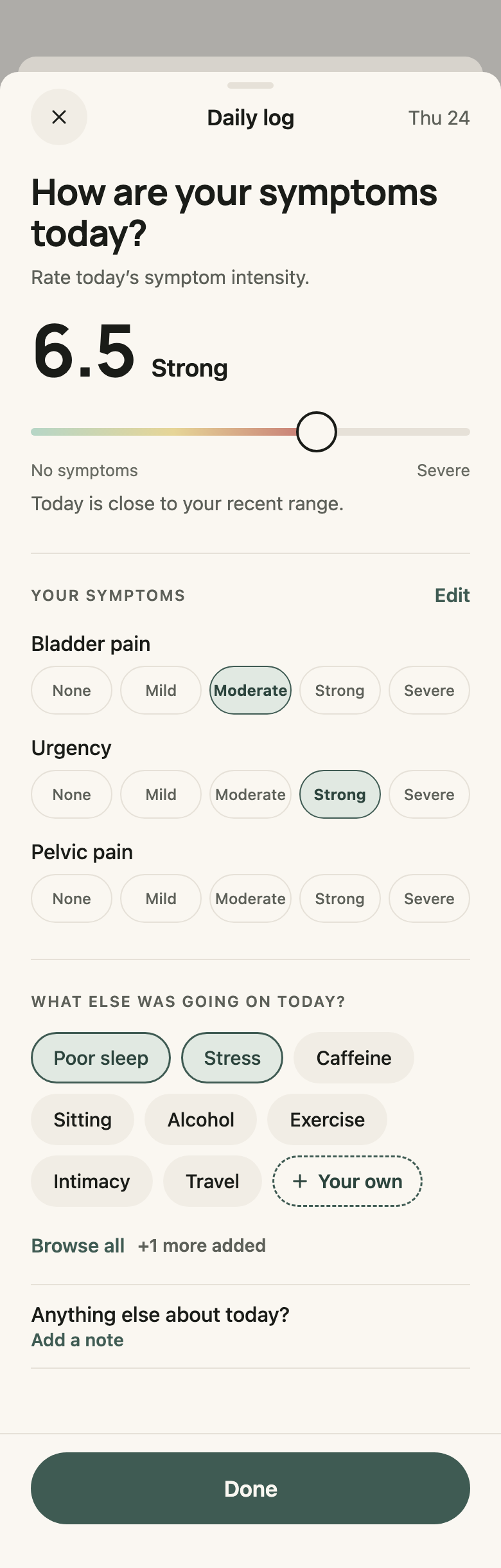

Endometriosis symptoms extend well beyond the period
The best-known symptom of endometriosis is painful periods. That is real, but it is a fraction of what many people experience. Pelvic pain in endometriosis can be present throughout the month — before the period begins, around ovulation, during or after sex, and sometimes with no clear cycle timing at all.
Bladder symptoms are common in endometriosis, particularly when lesions involve the bladder or ureter. Urgency, frequency, and pressure that worsen around menstruation are well-documented but frequently attributed to other conditions first. Bowel symptoms — cramping, bloating, irregular transit — are also part of the picture for many people, and they do not always line up neatly with the calendar.
Fatigue is one of the most reported endometriosis symptoms and one of the hardest to convey in a short appointment. It is not just tiredness from disrupted sleep. It is a whole-body depletion that tends to track with symptom severity, and it rarely appears in isolation.
The cycle is context, not a complete explanation
Cycle timing is the first layer of any endometriosis symptom record, and it matters. But it does not explain why one period is dramatically harder than the last. The cycle phase tells you when the body is under a particular hormonal load. It does not tell you what else was happening at the same time.
Sleep disruption, elevated stress, prolonged sitting, and changes to activity level can appear before endometriosis symptoms worsen, just as they do for IC and other pelvic conditions. When these inputs stack in the days leading up to or during menstruation, the period that follows can feel more difficult than one that arrived after a steadier week.
The record that captures this shows you the combination: cycle day alongside sleep quality, stress level, physical activity, and symptom severity. That combination, repeated across several cycles, starts to show which factors outside the cycle timing show up before your worst days. That is information the cycle alone cannot give you.
Why endometriosis symptoms are hard to describe at appointments
Endometriosis takes an average of seven to ten years to diagnose. That delay is shaped by many things, but one of them is how hard it is to translate a lived experience of diffuse, shifting pain into a description that conveys its actual scope.
"I have pain during my period" understates what is happening for most people with endometriosis. "Pain around ovulation, pressure and urgency with my bladder for about a week before my period starts, extreme fatigue for the first three days, bowel cramping that is unpredictable" — that is closer to the actual record. But most people do not have that level of detail ready in the room, because they have not tracked it systematically.
Endometriosis symptom tracking does not diagnose the condition. But it does give you the language to describe what is happening in enough detail that a clinician can hear it clearly. The difference between a vague description and a grounded one is often what determines whether symptoms are taken seriously.
What an endometriosis symptom record should capture
A useful endometriosis symptom tracking record starts with cycle day. Beyond that, it captures pelvic pain intensity, bladder and bowel symptoms, fatigue level, sleep, and stress. That combination — logged daily, across three or four full cycles — gives you enough structure to see what changed before symptoms got worse.
Severity matters. A record that only notes whether symptoms were present misses the range that makes patterns visible. Logging that Friday was a 3 and Tuesday was an 8, and then seeing that the Tuesday entries consistently follow two days of disrupted sleep, is the kind of information that changes what the record can tell you.
You are not looking for certainty about one cause. You are building a picture specific enough to describe what your body actually does across the month — in enough detail to share with the people treating you.
Why this matters
Endometriosis is hard to convey at appointments because the experience is diffuse and shifts across the month. The description that gets written down rarely matches the full picture — and the gap between what you experience and what gets documented is part of why diagnosis takes so long.
A symptom record built across several cycles gives you specific, grounded language for what your body actually shows. Not a diagnosis. Just the detail you need to describe what is happening in a way that can be heard.
Common questions
- What should you track with endometriosis?
- A useful endometriosis symptom tracking record includes cycle day, pelvic pain severity, bladder and bowel symptoms, fatigue, sleep, and stress. Logging these together across several cycles makes it easier to see which combinations of factors can show up before symptoms worsen.
- Does endometriosis pain only happen during your period?
- No. Pelvic pain in endometriosis can appear throughout the month — before the period begins, around ovulation, during or after sex, and at other times with no clear cycle link. Bladder urgency, bowel symptoms, and fatigue are also part of the picture for many people.
- Why is endometriosis so hard to describe at appointments?
- The experience of endometriosis is diffuse and shifts across the month. Without a consistent record, it is hard to convey the full scope of symptoms in a short appointment. A symptom diary built over several cycles gives you specific language for what actually happens, rather than a compressed summary.
- Can a symptom diary help with endometriosis?
- Keeping a symptom diary for endometriosis does not diagnose the condition, but it can help you describe your symptoms in enough detail to be taken seriously. A record that captures pain, bladder and bowel symptoms, fatigue, and cycle timing across multiple cycles builds the kind of specificity that appointments often lack.
Sources