Understanding your symptoms
Frequent urination that is not a UTI.
When you need to pee constantly and the urine test comes back clear, it can feel like you have no answers. There are real explanations — and they are more common than most people realize.
By Intero · Updated June 15, 2026 · 8 min read
Intero is observational, not diagnostic. Journal content is informational only and is not medical advice.
Frequent urination with a negative urine test usually points to overactive bladder, IC, or pelvic floor changes. Here is what each looks like and how to start understanding your pattern.
You go. Twenty minutes later, you feel like you need to go again. The urgency is real. The discomfort is real. But the urine test comes back negative, the antibiotics do nothing, and the doctor says there is no infection.
This is one of the more disorienting places to find yourself. Frequent urination without a UTI is not imagined — it is a recognized pattern with known causes. But because the most familiar explanation (a urinary tract infection) has been ruled out, many people spend months or longer without a name for what is happening.
There is almost always a real cause. It just does not show up on a urine culture.
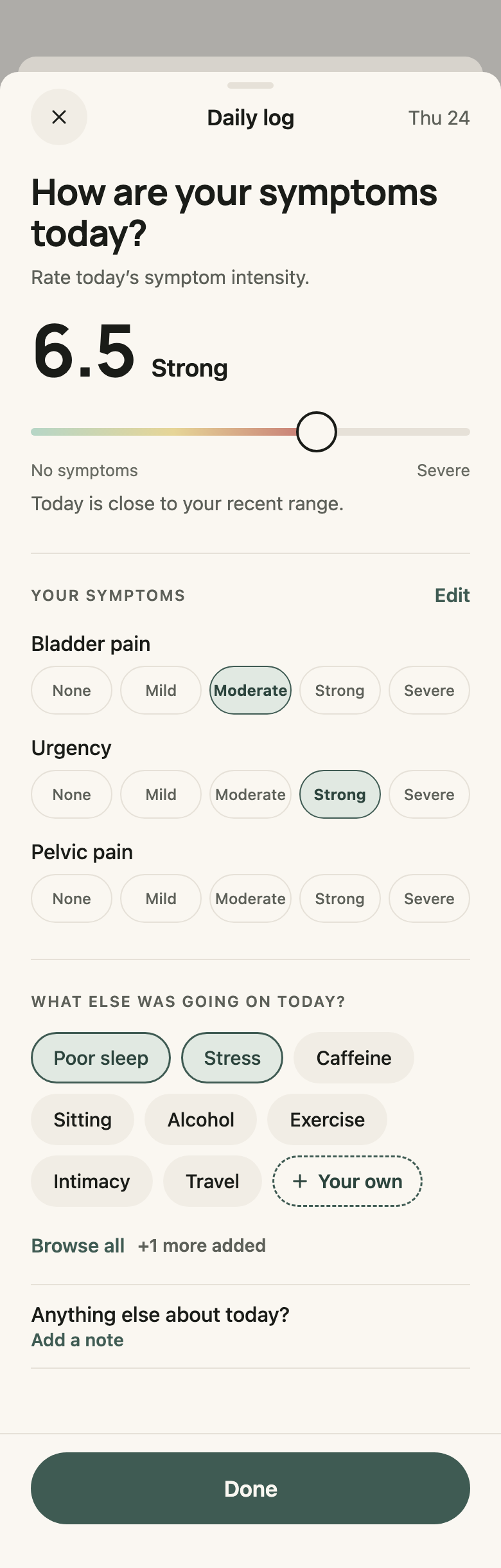
Keep a symptom history with Intero
Start with a daily entry, then build a record you can return to.
- Record symptoms and context.
- Review your history over time.
- Prepare a summary for appointments.

What frequent urination without infection actually feels like
The experience tends to have a particular quality. The urge arrives suddenly, often before the bladder is actually full. Sometimes there is pressure, sometimes burning, sometimes just an insistence that won't wait. You go, and the relief is partial or brief. Within the hour, the cycle begins again.
What makes this different from a UTI — aside from the negative test — is that the symptoms don't follow the arc of an infection. With a UTI, there is usually an onset, a worsening, and then resolution with antibiotics. Frequent urination from other causes doesn't resolve that way. It persists. It fluctuates. Some days are worse than others for reasons that aren't obvious.
People who don't have a name for it often describe it as just having a "small bladder" or being unusually sensitive to fluids. Those explanations are not wrong, exactly — but they're incomplete. The bladder itself may be responding normally to signals that are dysregulated, or the bladder wall may be reacting to conditions that have nothing to do with fluid intake.
The conditions most often behind it
Overactive bladder (OAB) is one of the most common causes of frequent urination in the absence of infection. OAB is a condition in which the detrusor muscle — the muscle that controls bladder contractions — fires involuntarily, producing urgency even when the bladder is only partially full. The urgency is real and physical, not psychological. The bladder genuinely signals "go now" even though there is no medical reason it needs to.
Interstitial cystitis (IC), sometimes called bladder pain syndrome, produces a related but distinct set of symptoms: frequency, pressure, urgency, and often burning that is not explained by infection. IC involves chronic irritation of the bladder wall. Unlike OAB, IC typically produces pelvic pain or pressure alongside the frequency, and the pattern often waxes and wanes over weeks rather than hours.
Hormonal changes — particularly those that accompany perimenopause and menopause — can alter bladder sensitivity and contribute to increased frequency. Pelvic floor dysfunction is another factor that shows up less often in lay explanations but matters clinically: a pelvic floor that is too tight or poorly coordinated can affect bladder behavior in ways that produce urgency and frequency without any infection present.
These conditions are not mutually exclusive. Some people with OAB also have IC-like symptoms. Some people with pelvic floor dysfunction have features of both. The overlap is common enough that getting to the right explanation often takes time and careful observation.
Why this is so hard to figure out without a record
Frequent urination without infection is difficult to describe in a short appointment. The doctor asks how often you go. You say "a lot." They ask if it's better or worse with anything. You think about it and genuinely don't know — because without tracking, the pattern is invisible. It's happening all the time, but you can't say whether it's better on some days, worse after certain foods, tied to stress, or completely unpredictable.
This is one place where the distinction between the conditions matters. OAB symptoms can vary considerably across the day and be related to fluid intake, caffeine, and activity. IC symptoms often follow a slower rhythm — better periods and rougher stretches that span days or weeks, sometimes connected to sleep, stress, diet, or sitting for long periods. Pelvic floor involvement often shows up around specific postures, activities, or emotional states.
Without at least a few weeks of tracking, it is genuinely hard to see which pattern you are in. The urgency feels the same in the moment regardless of cause. The differentiation happens in the structure over time: what precedes days when symptoms got worse, whether better stretches follow any consistent arc, whether certain inputs make things reliably worse.
What paying attention to your pattern can show
A useful record for frequent urination starts simple: how often you go, how urgent it felt, and a rough sense of how the day felt overall. From that baseline, you can start adding context — what you drank and when, sleep quality, stress level, whether you sat for long stretches. Two or three weeks of this is usually enough to start seeing something.
The pattern, when it appears, tends to answer the questions that are hardest to answer from memory alone. Were days when symptoms got worse actually random, or did they tend to follow poor sleep? Is the urgency worse in the afternoon, or is it consistent through the day? Does caffeine reliably produce more frequency, or is it something else? These are the questions that make a conversation with a doctor or specialist more useful — because you are not estimating, you are describing something you observed.
Intero's free printable symptom forms are a good starting point if you want to begin logging before committing to an app. They cover the key inputs — frequency, urgency, fluid intake, sleep — in a format designed for this kind of tracking. The app adds the ability to see patterns across weeks, but the forms work if you prefer paper or are early in figuring out whether this is worth tracking closely.
Why this matters
Frequent urination without a UTI can go unnamed for a long time. The test is negative, the antibiotics don't help, and the explanation stays out of reach. Without a record, it is genuinely hard to describe the pattern or see what is driving it.
Tracking when you go and how the urgency feels — alongside sleep, stress, and fluid intake — is how the pattern becomes visible. Over a few weeks, what felt random starts to show a shape you can bring to an appointment and actually discuss.
Common questions
- Why do I need to pee so often if I don't have a UTI?
- Frequent urination without a UTI is often caused by overactive bladder, interstitial cystitis, hormonal changes, or pelvic floor dysfunction. These conditions produce real urgency and frequency without any bacterial infection being present.
- Can overactive bladder cause frequent urination without pain?
- Yes. Overactive bladder typically presents as urgency and frequency — the sudden need to go, even when the bladder is not full — without significant pain. Pain or burning alongside frequent urination is more characteristic of interstitial cystitis or a UTI.
- What is the difference between overactive bladder and interstitial cystitis?
- Overactive bladder is primarily a problem with the bladder muscle contracting too readily, producing urgency without necessarily causing pain. Interstitial cystitis involves chronic irritation of the bladder wall and tends to produce frequency alongside pressure or burning. The two conditions can overlap. A specialist can help distinguish them.
- How do I know if frequent urination is something to take seriously?
- Frequent urination that is persistent, interferes with daily life, or occurs alongside pain, burning, or pressure is worth bringing to a doctor — especially if it is not explained by a UTI. Tracking when you go and what the urgency feels like over a few weeks gives you something concrete to describe at an appointment.
Sources