Understanding your symptoms
What overactive bladder actually feels like.
Overactive bladder symptoms rarely show up as one clear thing. They show up as a string of small adjustments you have stopped noticing, until you describe a normal day out loud and hear how much of it is built around your bladder.
By Intero · Updated June 23, 2026 · 7 min read
Intero is observational, not diagnostic. Journal content is informational only and is not medical advice.
Overactive bladder symptoms rarely look like one clear thing. They look like sudden urgency, frequent trips, and night waking that quietly reshape a normal day.
You map every outing by where the bathroom is. You go before you leave, not because you need to but because waiting an hour without knowing feels risky. You wake up two or three times a night, every night, and have stopped thinking of that as unusual. None of this feels like a symptom while it is happening. It feels like a personality trait, or a habit, or just how your body is.
Overactive bladder, OAB, is the medical term for this pattern: a sudden, strong urge to urinate that is hard to put off, usually paired with going more often than seems normal, day and night. It is common, more common than most people who have it realize, and it is rarely talked about until it has already reshaped someone's routine.
This is not a guide to fixing it. It is a description of what OAB symptoms tend to feel like from the inside, so you can recognize whether what you are dealing with has a name, and what comes next if it does.
Download a printable symptom diary
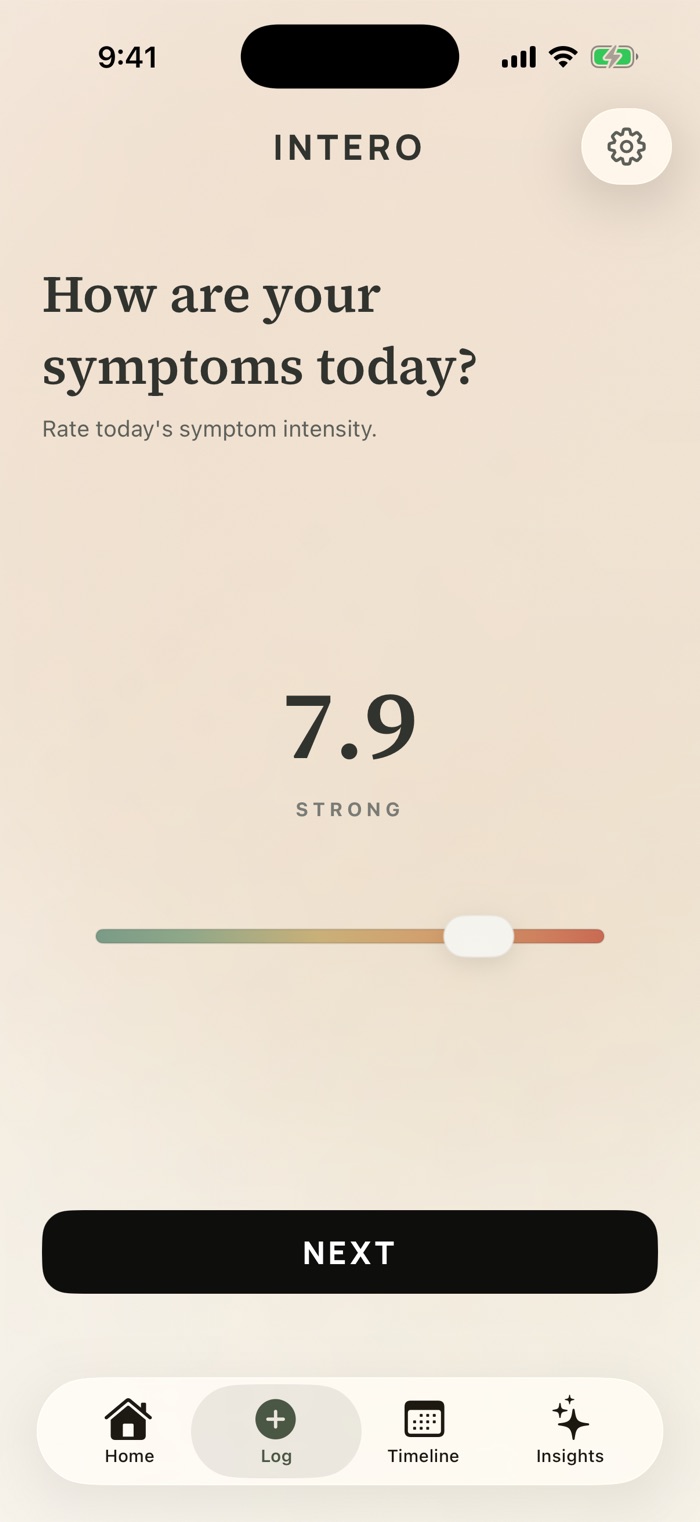
Use the PDF today, or track the same symptoms on iPhone with Intero:
- Track urgency and frequency in seconds.
- See what changed before urgency spiked.
- Bring a clear pattern to your doctor.

The urge that's hard to put off
The defining OAB symptom is urgency: a sudden need to urinate that arrives with little warning and feels difficult to postpone, even when the bladder is not actually full. People describe it as a switch flipping. One moment it's fine. The next, you can't think about anything else until you've gone.
This is different from a normal full bladder, which builds gradually and can usually wait. Urgency from OAB tends to spike fast and demand attention immediately, sometimes triggered by something as small as putting a key in the front door or hearing running water. The urge itself, not just the trip to the bathroom, is the symptom worth naming.
Frequency tends to ride along with it: needing to go more than eight times in 24 hours, or waking more than once a night to urinate, a pattern called nocturia. Some people also have urge incontinence, a small leak before they make it to the bathroom. Not everyone with OAB has every piece. The urgency is usually the part that is there no matter what else is.
Why this gets misread as a habit instead of a symptom
OAB symptoms develop slowly enough that they get absorbed into routine instead of registering as something to mention to a doctor. Scoping out the bathroom in a new place, leaving early to beat traffic so there is no risk of being stuck, drinking less before going out. Each adjustment feels reasonable on its own. Stacked together over months or years, they are evidence of something that was never named.
Part of the reason it stays unnamed is that OAB is often framed, when it is talked about at all, as an older person's issue or an embarrassing one. Neither is accurate. It shows up across age groups, and the urgency itself is a signal from the bladder muscle, not a character flaw or a sign anything is being done wrong.
The bladder muscle in OAB tends to contract involuntarily, even when there is not much urine to push out. That is what produces a strong urge on a bladder that is not actually full. It is a real, physical mechanism, which is why working around it with willpower or routine changes only goes so far.
What makes OAB symptoms hard to describe at an appointment
Ask someone with OAB how often they go in a normal day and most people guess. The urgency happens often enough that it stops being counted, the same way you would not count how many times you check a phone. By the time a doctor asks what triggers it, the honest answer is usually some version of: I do not know, it just happens.
But OAB symptoms are rarely random. Caffeine, alcohol, certain foods, dehydration that swings the other way into concentrated urine, stress, and even cold weather can all make urgency worse for some people and not others. The pattern is individual, and it is invisible without something written down, because the gap between a trigger and the urge that follows can be hours, not minutes.
This is the same problem that shows up across most bladder and pelvic conditions: the data that would explain the pattern lives in memory, and memory is bad at holding onto something that happens five, eight, ten times a day. A vague sense that "caffeine makes it worse" is not the same as being able to say it.
What a few weeks of paying attention can show
A simple OAB record does not need much: how many times you went, how strong the urge was, what you drank, and roughly when. Logged for a couple of weeks, this turns a vague sense of "it's worse some days" into an actual shape. Maybe the night trips track tightly with what you drank after 6pm. Maybe stress weeks have noticeably more urgency than calm ones, even with the same fluid intake.
None of this replaces a urologist visit. A formal OAB diagnosis still depends on ruling out infection and other causes. But walking into that appointment with two weeks of actual frequency and urgency data, instead of a guess, changes what the conversation can cover. Intero is built for exactly this kind of daily log, and the free printable bladder diary is a fine place to start if paper is easier for now.
The goal is not to explain away the urgency. It is to stop carrying it as a vague, constant background fact and start seeing it as something with a shape, on certain days, around certain things. That shift, on its own, is often the first real progress someone makes with overactive bladder symptoms before any treatment even starts.
Why this matters
OAB symptoms develop slowly enough to get absorbed into routine instead of registering as something to mention to a doctor. The urgency feels like a habit, not a symptom, until someone describes a normal day out loud.
A short record of how often, how strong, and what came before turns a vague sense of "it's worse some days" into a pattern you can actually point to, which is what most appointments are missing.
Common questions
- What are the main symptoms of overactive bladder?
- The core OAB symptom is a sudden, strong urge to urinate that is hard to postpone. It is often paired with urinating more than eight times in 24 hours, waking at night to urinate, and sometimes a small leak before reaching the bathroom.
- What does an OAB urge feel like compared to a normal full bladder?
- A normal full bladder builds gradually and can usually wait. OAB urgency tends to arrive suddenly, sometimes triggered by something small like a key in a door, and feels much harder to put off even though the bladder may not be very full.
- Is overactive bladder just something that happens with age?
- No. OAB shows up across age groups and is caused by the bladder muscle contracting involuntarily, not by getting older or doing anything wrong. It is under-discussed, not rare.
- What triggers overactive bladder symptoms?
- Common triggers include caffeine, alcohol, dehydration, stress, and certain foods, but the pattern is individual. Keeping a simple log of urgency, frequency, and what preceded it over a couple of weeks is usually the clearest way to see which ones apply to you.
Sources