Understanding your symptoms
Pelvic pain without a diagnosis.
Pelvic pain without a diagnosis can feel like a verdict: the pain is real, but every test comes back clear. There are explanations the standard tests do not catch, and a way to start seeing your own pattern while you look for answers.
By Intero · Updated June 15, 2026 · 8 min read
Intero is observational, not diagnostic. Journal content is informational only and is not medical advice.
Real pelvic pain and every test normal? Many causes are functional, not structural — pelvic floor dysfunction, CPPS, bladder pain syndrome. Here is how to start seeing your pattern.
You have pelvic pain that has not gone away. You have been to appointments. There was probably an exam, a urine test, maybe an ultrasound or a referral. And the result, more than once, was some version of the same sentence: everything looks normal. This is what pelvic pain without a diagnosis looks like from the inside.
It is one of the more isolating places to be, because the absence of a name gets heard as the absence of a problem. The pain is still there. The tests just did not explain it.
This is not a path to a diagnosis. It is about what you can do while the answer is still missing: stop carrying the pain only in memory, and start seeing the shape of it.
Keep a symptom history with Intero
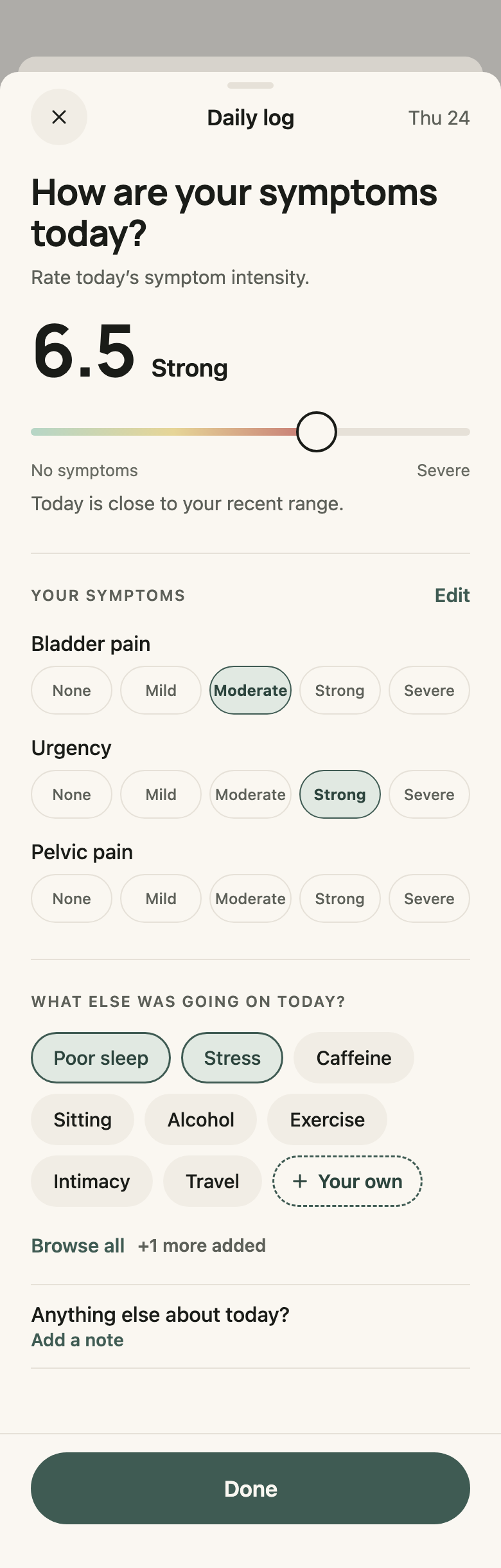
Start with a daily entry, then build a record you can return to.
- Record symptoms and context.
- Review your history over time.
- Prepare a summary for appointments.

What pelvic pain without a diagnosis tends to feel like
The pain does not always stay in one place. It can sit low in the abdomen, behind the pubic bone, in the perineum, around the bladder, or low in the back. Some people feel a constant dull ache. Others feel pressure that builds through the day, or a deep soreness that flares and settles for reasons that are hard to name.
Sitting often makes it worse. So can a long, stressful stretch, or a run of short nights, though the connection is rarely obvious in the moment. The pain can sit at a low level every day and then, every so often, become the only thing you can think about.
What makes this kind of pain so hard to hold is the gap between how real it is and how little it shows. You know something is happening in your body. The people you have asked for help cannot point to what. That gap is exhausting, and it is not a sign that you are imagining anything.
Why pelvic pain so often comes without a diagnosis
A standard pelvic pain workup is built to find specific things: an infection, a stone, a cyst, visible endometriosis, a structural problem on a scan. When those are present, you get a diagnosis. When they are absent, the workup tends to stop, and you are left with a normal result and an unsolved problem.
The trouble is that many causes of chronic pelvic pain are functional rather than structural. They are about how the muscles, nerves, and organs in the pelvis are behaving, not about something a scan can photograph. Pelvic floor dysfunction, where the pelvic floor muscles hold too much tension, is a common one. So is chronic pelvic pain syndrome, often shortened to CPPS, a broad term used precisely when ongoing pelvic pain has no single clear cause. Bladder pain syndrome and nerve-related pelvic pain belong in the same category.
None of these reliably show up on tests that look for infection or visible damage. A normal ultrasound does not rule them out. This is why so many people with real, ongoing pain end up with pelvic pain without a diagnosis: not because nothing is wrong, but because the usual tests are not built to catch what is.
Why unexplained pelvic pain is hard to see without a record
Chronic pelvic pain rarely holds still. There are easier days and days when symptoms got worse, and the reason for the difference is almost never obvious while it is happening. Asked at an appointment whether anything makes it better or worse, most people genuinely do not know. Not because there is no pattern, but because the pattern is spread across days and lost to memory.
The useful information often sits a day or two before a rougher stretch, not in the same hour. A long period of sitting, a tense week, a run of short nights. By the time the pain peaks, whatever came before it has already faded from memory, and what is left is the sense that it arrived from nowhere.
Without some record, the questions that matter most stay unanswerable. Is it worse after poor sleep, or does it only feel that way? Does sitting reliably set it off, or is that coincidence? These are the questions a careful clinician asks, and the ones that are impossible to answer from recall alone.
What paying attention to the pattern can show
A useful record for undiagnosed pelvic pain starts simple: a daily rating of the pain and where it sat, plus a little context. How you slept, how stressed you were, how long you sat, whether you moved much. If a menstrual cycle is part of the picture, note that too. Two or three weeks in, the entries start to add up to something.
What appears is not a diagnosis. It is a description. The days when symptoms got worse stop looking random and start lining up with something: the poor sleep that came first, the week that was unusually tense, the stretch of long days at a desk. Seeing that does not fix the pain. It does turn a vague, shifting experience into something specific you can point to.
That specificity is what changes the next appointment. Instead of "it hurts and I do not know why," you can describe a pattern you actually observed. Intero is built for this kind of tracking, and the free printable pelvic pain forms are a fine place to start if you would rather begin on paper. Either way, the record is the part that lasts longer than the memory of any single hard day.
Why this matters
Pelvic pain without a diagnosis is hard to carry partly because a normal test result gets heard as nothing being wrong. But many causes of chronic pelvic pain are functional, not structural, and they do not appear on the scans that came back clear.
A record will not hand you a diagnosis. What it can do is turn a vague, shifting experience into a pattern you can see and describe, so the next conversation with a clinician starts from more than memory.
Common questions
- Why is there no diagnosis for my pelvic pain?
- Many causes of chronic pelvic pain are functional rather than structural — pelvic floor dysfunction, chronic pelvic pain syndrome, and bladder pain syndrome among them. They do not show up on the standard tests that look for infection, stones, or visible damage, so pelvic pain without a diagnosis is common even when something real is happening.
- Is chronic pelvic pain without a diagnosis common?
- Yes. A large share of people with chronic pelvic pain never receive a single clear structural diagnosis. The absence of a name does not mean the pain is not real or has no explanation.
- What can I do about pelvic pain with no diagnosis?
- While the cause is still unclear, keeping a record of your pelvic pain and what surrounds it — sleep, stress, sitting, movement — can make the pattern visible over time and give you something specific to bring to your next appointment.
- What should I track for unexplained pelvic pain?
- A useful record keeps a daily pain rating and where it sat, alongside context like sleep, stress, how long you sat, movement, and any cycle changes. Over several weeks, the combination can make a pattern visible.
Sources