CPPS and pelvic health
Understanding CPPS symptom patterns.
Chronic pelvic pain syndrome symptoms shift in ways that are hard to explain without a record. Tracking helps by showing what keeps appearing in your own history over time.
By Intero · Updated June 15, 2026 · 9 min read
Intero is observational, not diagnostic. Journal content is informational only and is not medical advice.
CPPS symptoms shift in ways that are hard to explain from memory. A record can show patterns, context, and changes over time.
Chronic pelvic pain syndrome is one of the more difficult conditions to track precisely because its symptoms do not follow a simple on-off pattern. Pressure, aching, urgency, and discomfort in the pelvic region can be present at a low level most of the time, then escalate for reasons that are not always obvious, then quiet back down, sometimes on their own, sometimes after rest, sometimes for no clear reason at all.
That variability is not a sign that the symptoms are imagined or inconsistent. It is a characteristic of how CPPS behaves. And it is exactly why a structured record is more useful than trying to reconstruct what happened from memory.
Keep a symptom history with Intero
Start with a daily entry, then build a record you can return to.
- Record symptoms and context.
- Review your history over time.
- Prepare a summary for appointments.
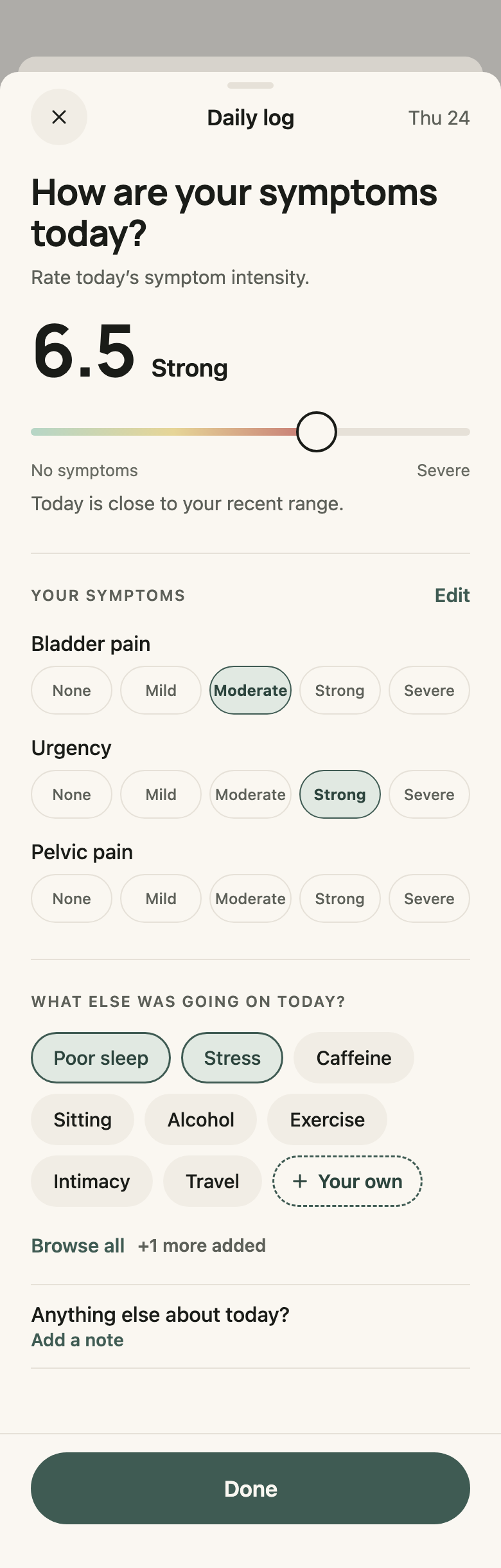

CPPS is a pattern condition.
What distinguishes CPPS from an acute condition is that it exists in a range rather than a fixed state. There is a baseline, the level of symptoms on an ordinary, unremarkable day, and there are departures from that baseline in both directions: rougher stretches where symptoms escalate, and quieter periods that provide relief.
Understanding your personal CPPS pattern means understanding your baseline and what moves it. That is different from looking for a cure or a single trigger. It is about becoming familiar enough with the range that a shift becomes legible, and that legibility is what makes the condition less disorienting to live with.
Why CPPS symptoms can feel hard to read.
One of the most frustrating aspects of CPPS for many people is that symptoms can escalate without an obvious immediate explanation. A day that looks identical on paper to a manageable day can suddenly be much harder. That unpredictability can make the shifts feel impossible to read.
What often matters is not a single acute event but the surrounding context over the preceding days: prolonged sitting, elevated psychological stress, disrupted sleep, reduced movement, or pelvic floor tension that has been building without release. The rough symptom day can feel sudden even when the context around it has been changing gradually.
A record that keeps the 24 to 48 hours before a rough symptom day is often where the most useful observation sits.
What can show up before CPPS symptoms worsen.
Across clinical observation and patient experience, certain inputs appear repeatedly in the context of CPPS symptom escalation: prolonged sitting (particularly in postures that increase pelvic floor tension), elevated stress without effective outlet, disrupted or insufficient sleep, decreased physical movement, and abrupt changes to routine.
Pelvic floor tension specifically is worth noting. CPPS is associated with elevated baseline tension in the pelvic floor muscles, and inputs that increase neuromuscular tension, such as sustained stress, prolonged static posture, and anxious anticipation, can contribute to escalation even when nothing acutely painful happened.
These are not universal. CPPS patterns are individual. But knowing which categories to watch is the starting point for finding which ones matter for your specific body.
What tracking gives you.
A structured symptom record for CPPS does not promise to make the condition simple. It promises to make it more legible. Over four to six weeks of consistent daily logging, many people can identify their baseline range and see what appeared before symptoms got worse.
That legibility does several things at once. It can make the changes feel less opaque, provide language for appointments with specialists, pelvic floor physiotherapists, or other clinicians, and create a clearer symptom history of what has been happening over time.
CPPS is a long-horizon condition. The record has to match that horizon, built to be useful not just in the first week but in the sixth month, when patterns have had time to become clear and the conversation with your care team can get more specific.
Why this matters
CPPS does not have a simple one-line explanation. What it has is a pattern, and patterns are only visible with enough structured data over enough time. The record is how that pattern becomes something you can talk about.
Tracking CPPS symptoms will not give perfect certainty. What it can do is make the pattern more legible, so you can describe it clearly and stop feeling like the changes are coming from nowhere.
Common questions
- What do CPPS symptom patterns usually look like?
- CPPS usually behaves like a range rather than a fixed state, with a baseline level of symptoms and periods where pelvic pain, pressure, urgency, or discomfort become harder before easing again.
- Do CPPS symptoms stay the same every day?
- No. CPPS symptoms often fluctuate. Many people have quieter periods and rougher stretches, which is why the condition can feel unpredictable without a structured record.
- What can show up before CPPS symptoms worsen?
- Common patterns include prolonged sitting, elevated stress, disrupted sleep, reduced movement, and pelvic floor tension building across the previous day or two.
- Why is tracking useful for CPPS symptoms?
- Tracking helps make CPPS more legible over time. It can show your baseline, what happened before symptoms got worse, and give you clearer language for appointments.
Sources