Language
Why we say flare.
Clinical language often describes what is happening to the body from the outside. The word flare describes it from the inside, and that difference matters more than it might seem.
By Intero · Updated June 15, 2026 · 5 min read
Intero is observational, not diagnostic. Journal content is informational only and is not medical advice.
The word flare earns its place in pelvic and urinary health because it describes something real: a temporary worsening with a shape, not just a bad moment.
There is a lot of vocabulary available for describing pelvic and urinary symptoms. Most of it comes from clinical settings, including dysuria, urgency, voiding dysfunction, and exacerbation. These words are accurate in a technical sense. They are also words that most people would never use to describe their own experience.
Flare is different. It is a word that people with IC, CPPS, pelvic floor dysfunction, and related conditions already use when they are talking to each other. It earned its place not through clinical consensus but through lived use.
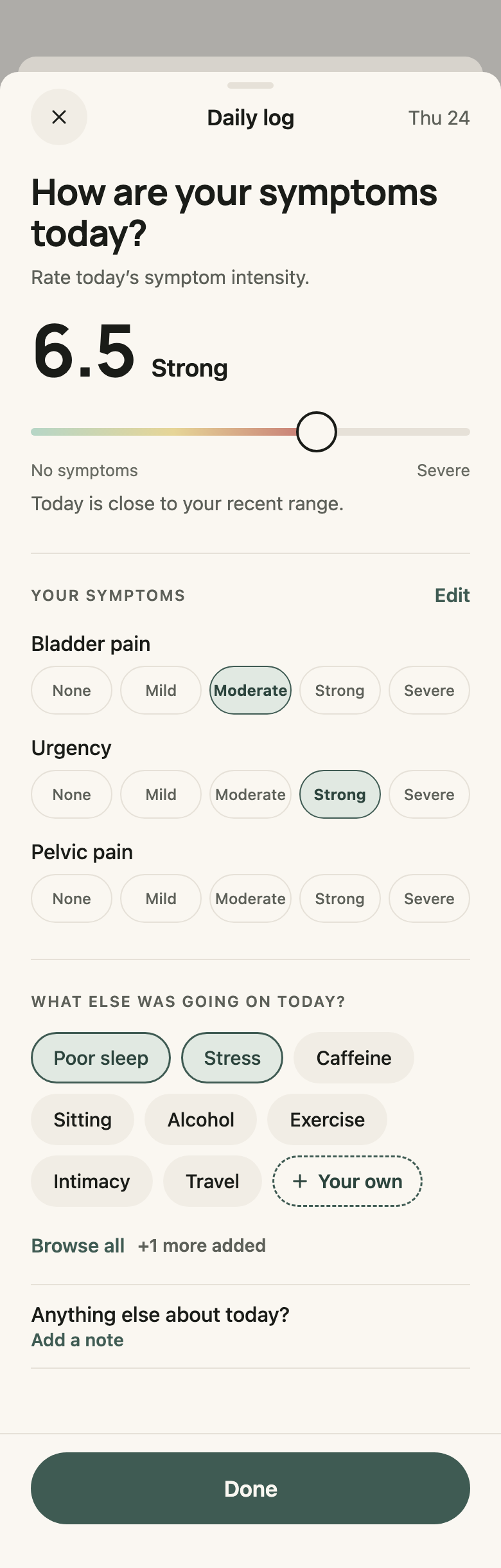
Keep a symptom history with Intero
Start with a daily entry, then build a record you can return to.
- Record symptoms and context.
- Review your history over time.
- Prepare a summary for appointments.

What flare captures that other words do not.
A flare is not just a bad day. It is a temporary intensification, something that arrives, has a shape, and eventually subsides. It is different from baseline in a way that is legible. It is not random. It has a before and an after.
The word carries that structure implicitly. When someone says "I am in a flare," there is a shared understanding that this is a departure from a more manageable state, that it is time-limited, and that something probably contributed to it. That understanding is compressed into one word.
Clinical language describes symptoms as events. Flare describes them as a state.
The clinical vocabulary for pelvic symptoms is mostly built around individual events, such as a void, an episode, or an exacerbation. This makes sense in a clinical context where the unit of analysis is often a discrete occurrence.
But people living with these symptoms do not experience them as discrete occurrences. They experience them as states that shift over time. A flare is a stretch of days, not a moment. The language has to hold that shape, and "exacerbation" does not hold it the way "flare" does.
Shared vocabulary is part of what makes tracking useful.
When a symptom tracker uses the same language its users already use to talk about their bodies, it reduces friction in a way that matters. You do not have to translate. You do not have to decide whether what you are experiencing counts as an "episode" in the clinical sense.
You already know what a flare is. You know when you are in one. The record captures that directly, without asking you to reframe your own experience into someone else's vocabulary.
When the language fits, people describe what is actually happening instead of what they think the form is asking for. That distinction is where accuracy is won or lost.
The word should stay anchored to observation, not judgment.
One risk with any vocabulary that comes from patient communities is that it can drift toward the judgmental or the catastrophizing. A flare should describe an observable shift in how the body feels, not a disaster, not a failure, and not a sign that things are getting worse overall.
In a useful symptom record, a flare is a data point with a shape. It arrived, it had a level of intensity, and it will resolve. The record's job is to describe that accurately, not to amplify it or minimize it.
Why this matters
The vocabulary a symptom tracker uses is part of the tool. Language that fits the user's experience reduces the distance between what they are feeling and what goes into the record. That distance is where accuracy is lost.
Flare already means something to people with pelvic and urinary conditions. Using it meets them where they are. The alternative is making them translate their experience into clinical vocabulary they would never use in their own lives.
Common questions
- What does a flare mean in pelvic or urinary health?
- A flare usually means a temporary intensification of symptoms that departs from baseline, has a recognizable shape, and eventually settles down.
- How is a flare different from just a bad day?
- A flare describes a state, not just a moment. It has a before and an after, and usually reflects a meaningful shift from a more manageable range.
- Why do people use the word flare instead of clinical terms?
- People already use flare in lived conversation because it fits the shape of the experience better than many technical terms that focus on isolated events.
- Should the word flare be used as a judgment?
- No. In a useful symptom record, flare should stay anchored to observation. It describes a shift in how the body feels, not a failure or a catastrophe.
Sources